Metal Roof Solar Mount System: A Buyer's Guide for Tin Roofs
A metal roof solar mount system is the structural interface that fixes photovoltaic modules to a trapezoidal, corrugated or standing seam metal roof. It is not a reduced ground mount. The roof sheet is thin, the load path runs into purlins, and every fastener is a potential leak point. This guide explains how metal roof mounting works, which parameters should be verified before ordering, and how the two 9Sun Solar tin roof systems - NS-tin roof-2 and NS-mini rail-1 - are specified.
What a Metal Roof Solar Mount System Is
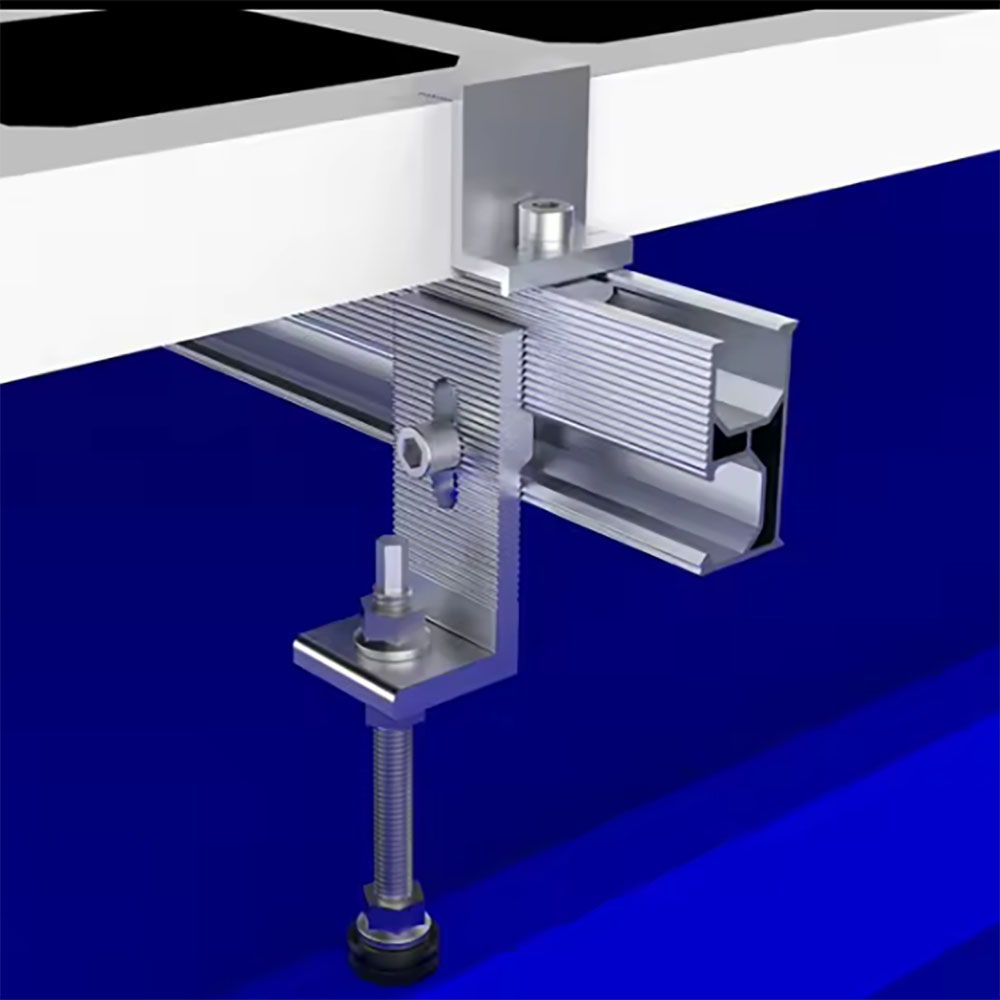
A metal roof solar mount system is a set of roof attachments, rails, clamps and fasteners that transfer PV module loads from the module frame into the roof structure beneath the metal sheet. Three parts do the work: the roof attachment (an L-foot, a mini rail, or a seam clamp), the rail that carries the module, and the mid and end clamps that lock the module frame to the rail.
The category covers several roof profiles. Trapezoidal and corrugated sheets are the common industrial and agricultural case. Standing seam profiles behave differently because the seam itself can become the attachment point. Residential metal roofs usually carry smaller arrays and are more sensitive to visible penetration. In all three cases the buyer is really evaluating four things: how the system connects to the structure, how it seals, how it resists corrosion, and what documentation the supplier can hand to an engineer or an authority.
Typical buyers of a metal roof solar mount system are commercial and industrial rooftop owners, EPC contractors, installers working on warehouses and factory buildings, distributors holding stock for residential and light commercial projects, and procurement teams qualifying a supplier for the first time.
Problem Definition: Why Metal Roofs Break Generic Mounting Assumptions
Metal roofs fail mounting designs for predictable reasons, and those reasons are the actual selection criteria.
- The sheet is thin and deflects. A metal roof sheet is not designed to take a concentrated point load from a solar array. Load has to be transferred into purlins or structural members, which means the installer must know where those members are before drilling.
- Every penetration is a water entry path. A penetrating system depends entirely on the quality and correct seating of the seal at each L-foot. Sealing is a component property, not an installation attitude.
- Roof profiles vary more than module frames do. Corrugation pitch, rib height and sheet thickness differ between suppliers and regions, so a bracket that fits one building may not seat correctly on the next.
- Corrosion is a design variable, not a coating claim. Coastal humidity, industrial atmosphere and rain exposure determine whether aluminium and stainless steel hardware are the correct choice for a given site.
- Documentation is part of the product. Projects in regulated markets need load information, material declarations and certification evidence before approval.
Industry Background: Where Metal Roof Mounting Sits
Metal roof mounting sits inside the wider solar mount system category, and the split between applications shapes which materials dominate. Reported market data for 2024 places ground-mounted systems at 55% and rooftop systems at 45% of the market, while aluminium accounts for 48% and galvanized steel for 44% of material usage.
| Market dimension | Reported share | What it means for buyers |
|---|---|---|
| Ground-mounted systems | 55% (2024) | Steel-heavy structures dominate utility-scale ground projects. |
| Rooftop systems | 45% (2024) | Roof work favours lighter structures and handling. |
| Aluminium material usage | 48% (2024) | Weight, corrosion behaviour and forming flexibility favour aluminium on roofs. |
| Galvanized steel material usage | 44% (2024) | Cost and stiffness favour steel in ground-mount structures. |
Source: Market Reports World, solar PV mounting systems market data, 2024 shares.
The pattern is consistent with how metal roofs behave in practice: an aluminium rail and attachment system keeps roof loading and manual handling within limits, while the module frame is clamped rather than bolted through. Steel still has a place, particularly where spans and stiffness drive the design.
Standards are the second structural fact of this category. UL 2703 is the safety and bonding standard for PV mounting systems in North America, published by UL Solutions. European projects may reference EN 1090 for structural execution. Some markets add their own design references - 9Sun Solar states that its mounting systems are designed with reference to JIS C8955:2017 and AS/NZS 1170, which are design benchmarks and should not be read as certificates of conformity.
Where Chinese Manufacturers Fit
China is a major supply base for solar mounting systems. A public PV supplier directory lists 1,280 mounting system manufacturers, and that figure is a directory listing count rather than a verified count of qualified suppliers. For a buyer entering this category, the practical consequence is that shortlisting has to rely on verifiable attributes rather than catalogue breadth: factory location, dated capacity statements, material grades, declared load ratings, certification scope, and warranty terms.
Detailed Solution: How 9Sun Solar Builds Metal Roof Systems
Xiamen 9Sun Solar Technology Co., Ltd. (9Sun Solar) is a solar PV mounting system manufacturer based in Xiamen, Fujian Province, China, established in 2018, with its own factory in Quanzhou, Fujian. Its product range covers solar ground mounting systems, solar roof mounting systems, solar farm mounting systems, solar carport mounting systems, balcony solar brackets, vertical solar panel fences, ground screws and solar PV cables.
For metal roofs the company offers two distinct mechanical approaches, which is useful because the correct choice depends on the building rather than on preference.
NS-tin roof-2: Direct Penetrating Fixing Through the Sheet
NS-tin roof-2 is a solar tin roof mount system designed for metal tin roof solar mounting scenarios and intended for residential, commercial and industrial, and public infrastructure applications. Its L-feet are bolted directly onto the metal roof's main supports (purlins) through the roof sheets, which creates a strong, direct and simple structural connection.
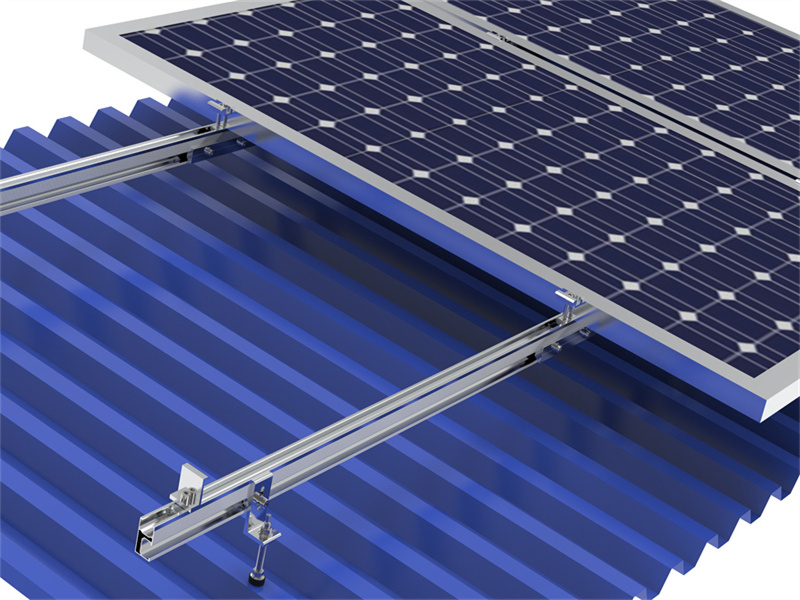
Waterproofing is handled at component level. Each L-foot has a rubber seal at its base, which protects the roof from leaks at the penetration. The structure is made from high-strength aluminium that resists rust and corrosion, and the system is described as working on most common metal roof types.
Declared technical parameters for NS-tin roof-2 are:
| Parameter | Declared value |
|---|---|
| System type | Solar tin roof mount system |
| Model designation | NS-tin roof-2 |
| Primary material | Aluminium AL6005-T5 with stainless steel components |
| Surface treatment | Anodized aluminium |
| Design wind load | ≤80 m/s |
| Design snow load | ≤150 cm |
| Colour options | Silver, black, or customized |
| Warranty | 10 years |
| Certification | CE |
The trade-off is explicit. A penetrating system gives a direct structural connection and a simple bill of materials, but it requires accurate purlin location, correct fastener torque, and a maintenance or inspection routine that treats the rubber seal as a serviceable component. Buyers should ask how the seal is specified and how replacement is handled on a 25-year asset.
NS-mini rail-1: Low-Profile, Reduced-Material Option
NS-mini rail-1 is a solar tin roof mini rail system for metal roof solar mounting applications, intended for residential, commercial and industrial, and public infrastructure industries. Its design logic is different from the L-foot solution: shorter rails are used to form a compact mounting plane rather than a continuous rail run.
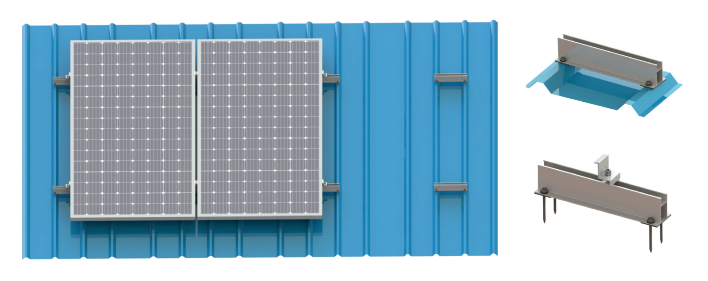
The mini rail design uses less aluminium than larger rail systems, which makes the system lighter and more cost-effective without changing the declared load envelope. The system is supplied with fewer parts than larger rail systems, and the smaller rails are easier for a single installer to handle and manoeuvre on the roof. The low-profile rail design sits closer to the roof, giving a cleaner finish.
Declared parameters match the tin roof system envelope: aluminium AL6005-T5 with stainless steel components, anodized surface, design wind load ≤80 m/s, design snow load ≤150 cm, silver, black or customized colours, 10-year warranty and CE certification.
The limitation is also explicit. A mini rail carries the module over shorter spans, so the permissible purlin spacing and module size combination must be checked per project. It suits roofs where the array sits close to the sheet and where material weight and installation time matter more than long rail runs.
Rails, Clamps and Grounding Components
The rail and clamp range behind these systems is shared across roof and ground applications, which matters for distributors who want one component inventory.
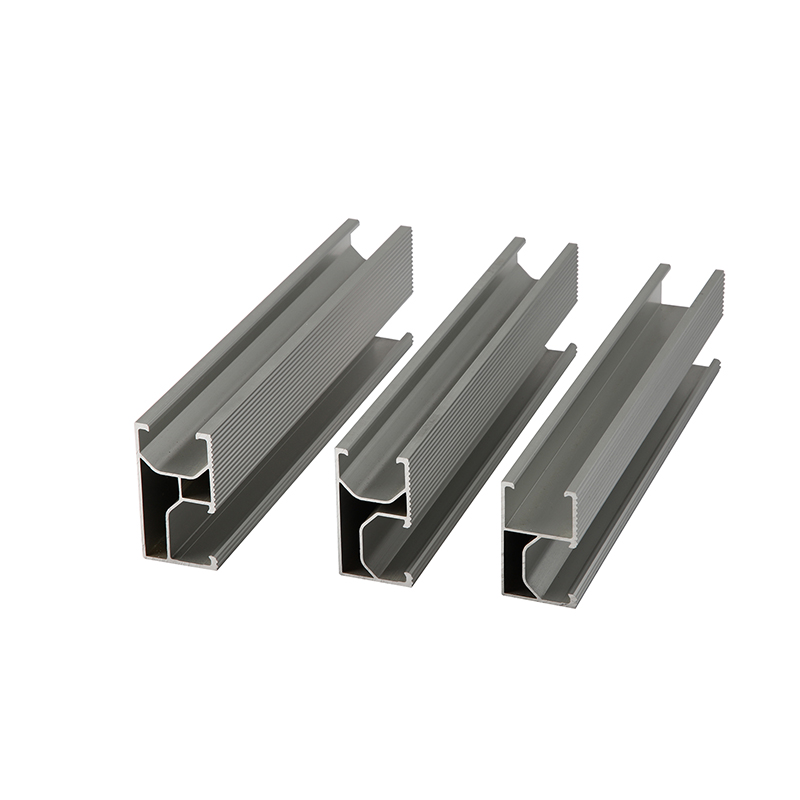
Solar rail is made of anodized aluminium alloy 6005-T5, with a design wind load of 60 m/s and a design snow load of 1.4 kN/m². Model designations are AR1, AR2, AR3 and AR46 in the AR series, plus BR1, BR2, BR3 and HR. The rails are supplied in pre-cut lengths with pre-drilled holes, and the modular design is intended to work with compatible mid and end clamps.
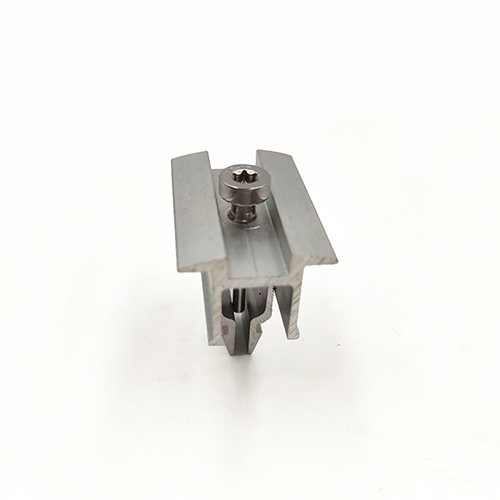
Solar clamp is the other half of the interface. The clamp range uses AL6005-T5 anodized aluminium with a 60 m/s wind load and 1.4 kN/m² snow load rating. The practical details are worth noting because they change installation time: an integrated grounding pin removes separate grounding hardware, one clamp family fits a wide range of module frame heights (typically 30-47 mm), the design is pre-assembled, and rotatable claws support both portrait and landscape module layouts.
For roofs that need tilt rather than a flush layout, 9Sun Solar also offers NS-Adjustable Leg-1, a solar adjustable leg bracket system with a 10° to 30° adjustable tilt range. It includes L-feet as a metal roof foundation option and expansion bolts for concrete foundations, and its leg assemblies are pre-assembled before shipping.
Manufacturing and Verification Notes
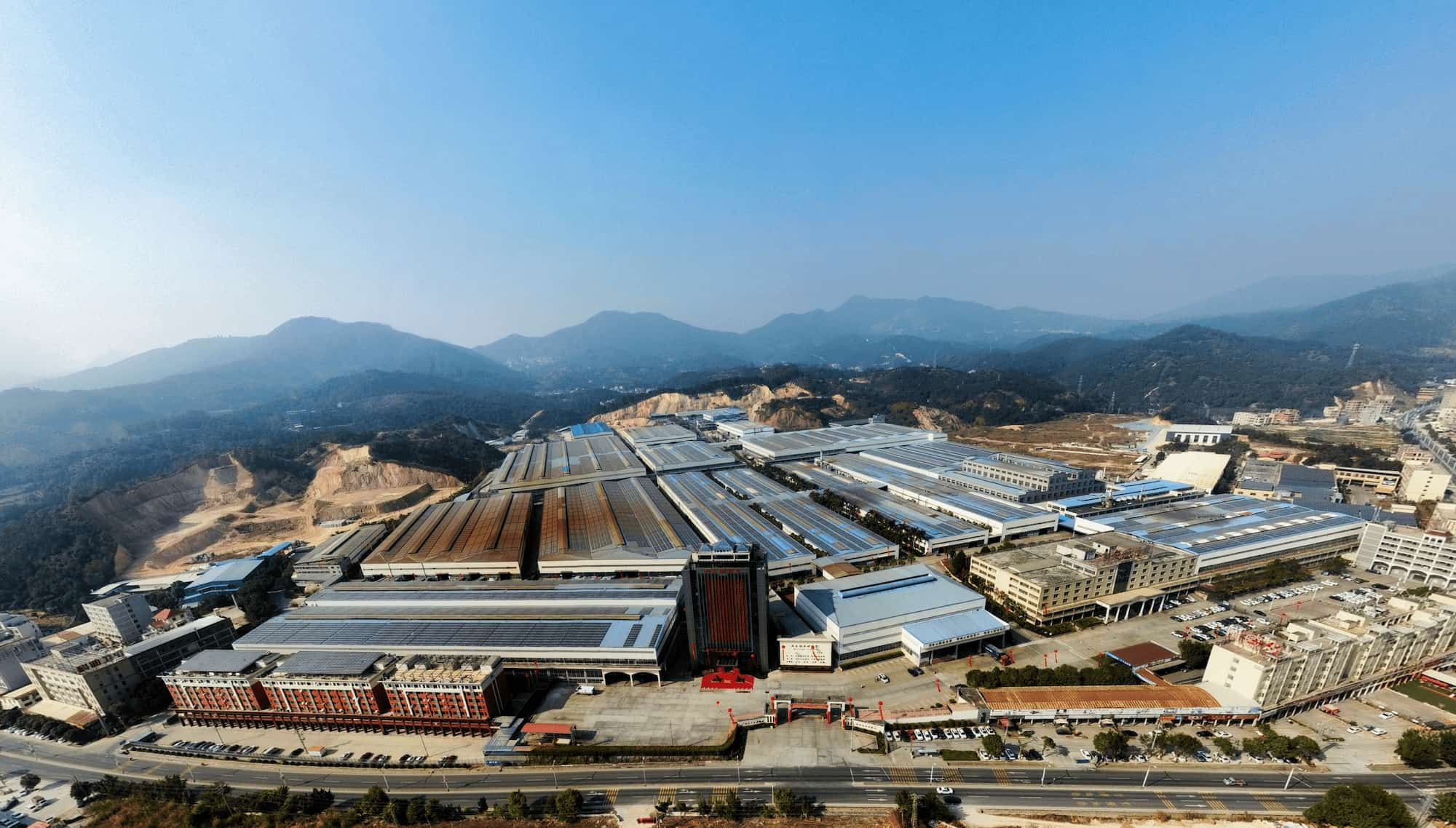
9Sun Solar reports a manufacturing facility of 500,000 m² in Quanzhou, Fujian, an annual production capacity of 2 GW for solar mounting systems, a team of 28 staff, and an R&D team of 7 engineers. Export business accounts for 99% of total sales, with major markets including Japan, South Korea, the Philippines, Singapore, Armenia, Nigeria, Bulgaria, Cuba, Lebanon, Malaysia, Mongolia, Switzerland, Saudi Arabia and Thailand. Production is carried out according to GB/T 5237, Japan (JIS) and America (AA) standards. The company also states 10-year warranty coverage for solar mounting systems and an actual service life of up to 25 years under proper use.
Step-by-Step: How to Specify a Metal Roof Solar Mount System
The selection sequence below is written for a buyer or engineer evaluating a metal roof project for the first time. It works for any supplier, not only 9Sun Solar.
Use Cases
Metal roof mounting decisions are usually made by building type rather than by product preference. The cases below reflect the scenarios the systems are declared for.
- Industrial and commercial metal rooftops. Warehouses, factory buildings and logistics roofs use trapezoidal or corrugated sheet over steel purlins. NS-tin roof-2 provides a direct structural connection; NS-mini rail-1 reduces material and handling weight on large roof areas.
- Agricultural buildings. Barn and shed roofs are often lightly structured and awkward to access. Fewer parts and single-installer handling reduce time on the roof.
- Residential metal roofs. Smaller arrays on tin roofs where visible penetration and leak risk are the owner's main concerns. The rubber seal at each L-foot and the low-profile mini rail option both address appearance and water entry.
- Coastal and high-humidity sites. Anodized aluminium components with stainless steel hardware are the specified material combination, which is the appropriate basis for salt-laden and humid environments.
- Snow-loading regions. The declared design snow load of ≤150 cm covers many cold-climate rooftops, subject to project verification.
- Projects that need tilt rather than flush mounting. Where the roof plane is unsuitable, the NS-Adjustable Leg-1 system offers a 10° to 30° adjustable tilt range with L-feet for metal roofs or expansion bolts for concrete.
Comparison Table: Which Tin Roof System Fits Which Project
The table below compares the two metal roof systems and the shared rail platform using only declared specifications.
| Attribute | NS-tin roof-2 | NS-mini rail-1 | Solar rail (AR / BR / HR) |
|---|---|---|---|
| System category | Solar tin roof mount system | Solar tin roof mini rail system | Solar rail component |
| Roof attachment | L-feet bolted through sheet into purlins | Compact mini rail mounting plane | Rail only; attachment supplied by system |
| Primary material | Aluminium AL6005-T5, stainless steel | Aluminium AL6005-T5, stainless steel | Anodized aluminium alloy 6005-T5 |
| Surface treatment | Anodized | Anodized | Anodized |
| Design wind load | ≤80 m/s | ≤80 m/s | 60 m/s |
| Design snow load | ≤150 cm | ≤150 cm | 1.4 kN/m² |
| Material efficiency | Standard rail and L-foot configuration | Uses less aluminium than larger rail systems | Pre-cut lengths and pre-drilled holes |
| Installation profile | Direct fixing, simple component set | Fewer parts, single-installer handling | Modular, compatible with mid and end clamps |
| Visual profile | Standard | Low-profile, sits closer to the roof | Depends on system configuration |
| Warranty | 10 years | 10 years | Not stated in the available specification |
| Certification | CE | CE | Not stated in the available specification |
All values are declared product specifications from 9Sun Solar product data. Project-specific verification is required before ordering.
Frequently Asked Questions
What certification should a metal roof solar mount system have for export markets?
It depends on the destination. CE certification documentation is the baseline for the European market, and the 9Sun Solar tin roof systems are stated as CE certified. For North America, UL 2703 is the safety and bonding standard for PV mounting systems published by UL Solutions; a supplier should be able to provide the certificate number, issuing body, scope and validity date rather than a logo. European structural projects may also reference EN 1090. Design references are a separate matter: 9Sun Solar states its mounting systems are designed with reference to JIS C8955:2017 and AS/NZS 1170, which are benchmarks and not certificates of conformity. Buyers should treat any certification claim as unverified until the certificate document is produced.
Can one metal roof mount system work across different roof profiles?
Partly. NS-tin roof-2 is described as working on most common metal roof types by bolting L-feet through the sheet into purlins, and NS-mini rail-1 is designed for metal tin roof mounting applications. Both are built from aluminium AL6005-T5 with stainless steel components and anodized surfaces. The limiting factor is the roof profile itself: corrugation pitch, rib height and sheet thickness vary between buildings, and standing seam roofs need a seam-specific attachment. The practical approach is to send the roof profile drawing and purlin layout to the supplier and request an attachment drawing before placing an order. 9Sun Solar states that it handles customized orders and has an R&D team of 7 engineers.
What drives the cost of a metal roof solar mount system?
Four factors dominate. First, aluminium content per kW: the mini rail design uses less aluminium than larger rail systems, which lowers material cost and weight. Second, part count and pre-assembly: pre-assembled clamps and pre-drilled rails reduce on-site labour, and labour is often a larger share of installed cost than hardware. Third, roof complexity: purlin spacing and profile irregularity change the number of attachment points. Fourth, colour and customization. For external benchmarking, reported residential aluminium mounting system pricing sits at roughly USD 0.25-0.45 per watt in 2026, which is a market reference range rather than a quotation. Metal roof projects should be quoted against a bill of materials derived from the actual roof drawing.
Can I review product documentation before committing to an order?
Yes, and it should be the first step. Ask for the product catalogue, the declared specification sheet for the specific model, installation instructions, material grades and any certification documents. For metal roof projects the useful pack is small but specific: the L-foot or mini rail drawing, the sealing detail, the declared wind and snow envelope, and the warranty terms. 9Sun Solar publishes a product catalogue that covers its ground, roof, farm, carport, balcony, vertical and component ranges, which is a practical starting point for a first screening pass before technical discussion.
What lead time and warranty apply to a metal roof solar mount system?
9Sun Solar states that production can be completed within one week after receiving orders at the earliest, and that solar mounting systems carry a 10-year warranty with an actual service life of up to 25 years under proper use. Both statements should be confirmed in writing for the specific model, quantity and colour option, because lead time depends on stock status and customization scope. A practical next step is to send the roof profile, purlin spacing, module dimensions and target market to the 9Sun Solar team at exp@9sunsolar.com or via WhatsApp at +86 13599517330, and request a model recommendation together with the current catalogue and lead time for your quantity.
Conclusion
A metal roof solar mount system is a small part of a PV project budget and a large part of its risk profile. The mechanical logic is straightforward: transfer load into purlins, seal every penetration properly, use materials that survive the site atmosphere, and document the load and compliance case before installation starts.
9Sun Solar approaches metal roofs with two declared options. NS-tin roof-2 gives a direct structural connection with L-feet bolted through the sheet into purlins, a rubber seal at each foot, and a ≤80 m/s wind and ≤150 cm snow envelope. NS-mini rail-1 uses less aluminium, fewer parts and a low-profile rail plane where material weight and installation speed matter more. Both are aluminium AL6005-T5 systems with anodized surfaces, stainless steel components, CE certification documentation, and a 10-year warranty. The shared rail and clamp platform, including integrated grounding pins and 30-47 mm frame compatibility, keeps the component inventory small for distributors.
What separates suppliers in this category is not the product description but the verification trail: dated capacity statements, certificate numbers, load documentation and a repeatable sealing detail. Those are the items worth putting on the first request for quotation.
Next Step
If you are specifying a metal roof project, the fastest way to a usable answer is to share the roof profile drawing, purlin spacing, module dimensions, target market and required quantity. The 9Sun Solar team can then confirm the appropriate system - NS-tin roof-2 or NS-mini rail-1 - together with the matching rail and clamp configuration.
Product catalogue: 9Sun Solar Product Catalog (PDF)
Email: exp@9sunsolar.com
WhatsApp: +86 13599517330
Website: www.9sunsolar.com
Have Questions or Need More Details?
Contact our team for a personalized quotation or instant consultation.
Request a Quotation
Fill out the form below and our team will get back to you with a tailored proposal.
WhatsApp Direct Chat
Prefer to chat in real-time? Message us on WhatsApp for instant assistance & quick answers.
- Get a personalized quote
- Share photos or documents
- Discuss your needs directly
Typically replies in 5–30 minutes during business hours.