Flat Roof Solar Mount System: A Buyer's Discovery Guide
A flat roof solar mount system is a structural assembly that secures photovoltaic modules to a low-slope or flat roof while managing tilt, wind uplift, drainage, and roof protection. It is more than a set of rails: the mounting principle determines whether the roof is penetrated, how ballast or mechanical fixing is designed, and how project approvals are documented.
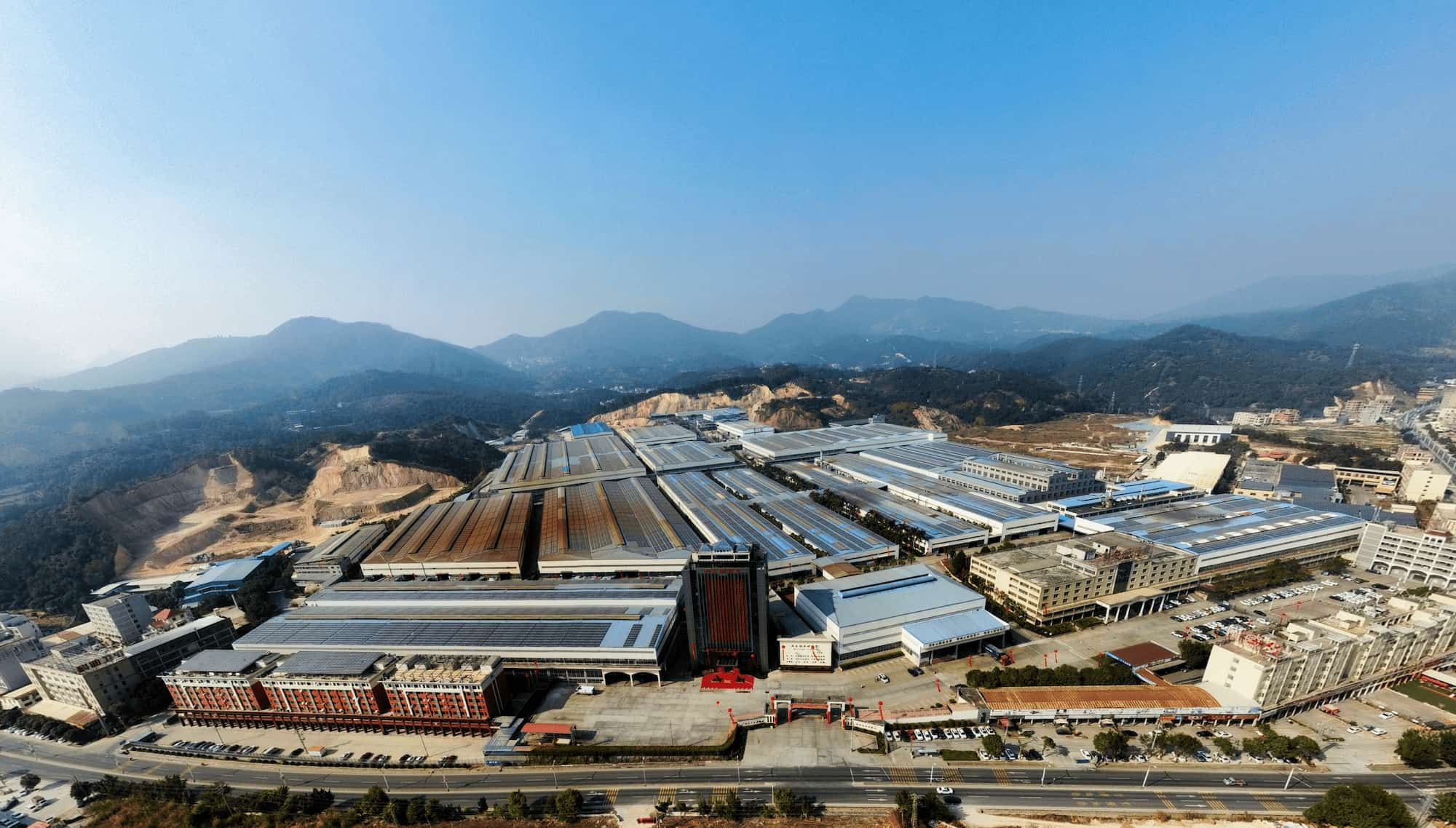
Xiamen 9Sun Solar Technology Co., Ltd. is a China-based solar PV mounting system producer founded in 2018, with its own factory in Quanzhou, Fujian, and a product range that includes solar ground mounting systems, solar roof mounting systems, solar farm mounting systems, solar carport mounting systems, balcony solar brackets, vertical solar panel fences, ground screws, and solar PV cables. For flat roof projects, 9Sun Solar lists three relevant product families: the NS-Roof Ballast-1 non-penetrating flat roof system, the NS-Roof Tripod-1 roof tripod system, and the NS-Adjustable Leg-1 adjustable leg bracket system.
Problem Definition: Why Flat Roofs Need a Different Mounting Approach
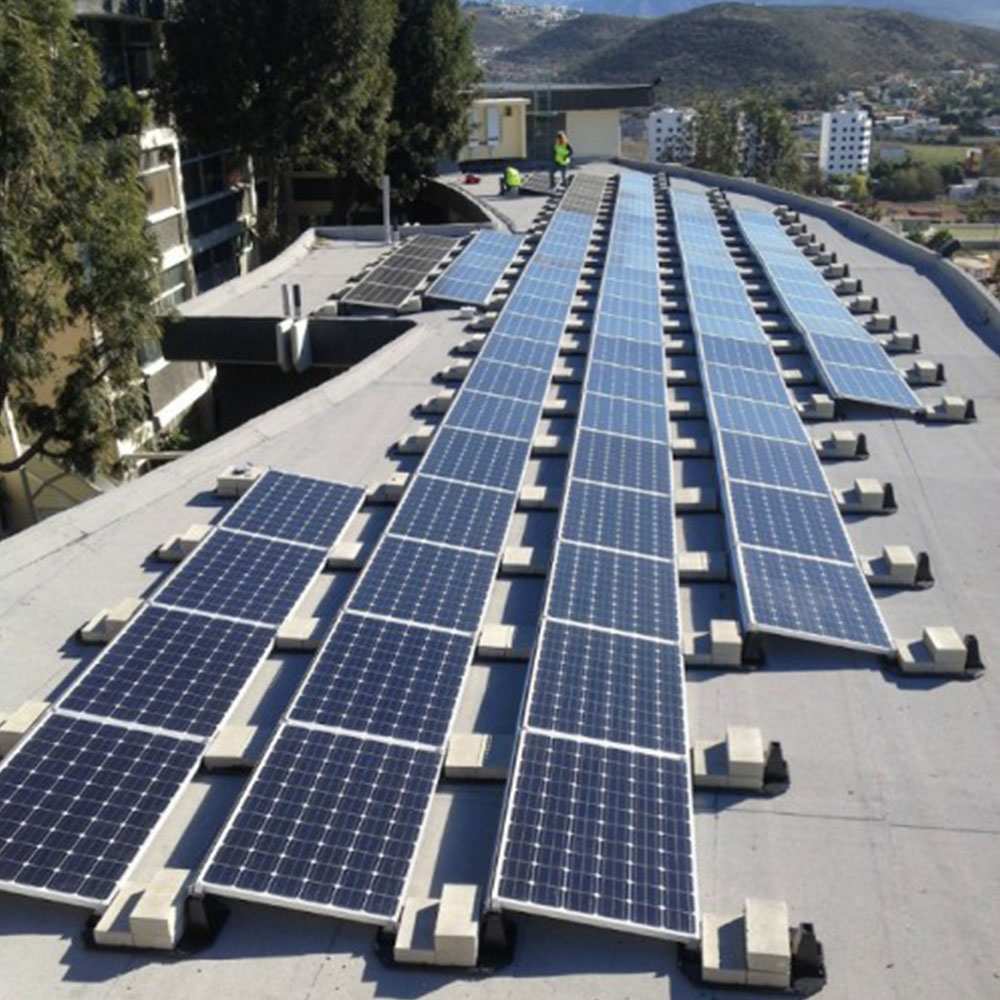
The central problem in flat roof solar mounting is not panel clamping. It is load transfer and roof protection. A flat roof often has a membrane, concrete, or metal surface; each surface has different tolerance for penetration, point loading, and thermal movement. The mounting system must hold the array in place without creating leaks, overloading the structure, or blocking drainage.
Flat roof projects also need an intentional tilt strategy. A low-slope roof does not provide the natural angle of a pitched roof, so the system may need to raise the modules to a suitable angle. That angle affects energy capture, row spacing, wind exposure, and the amount of ballast or fixing required. In practice, buyers compare flat roof solar mount systems on four points:
- Roof protection: non-penetrating ballast avoids drilling, while mechanical fixing may be required on some roofs.
- Structural safety: wind uplift and snow load must be checked for the specific site, not only the product datasheet.
- Installation labor: pre-assembled and modular components reduce time on the roof.
- Documentation: drawings, calculations, certifications, and warranty terms must match the project jurisdiction.
Industry Background: Flat Roof Solar in the Broader Mounting Market
Flat roof mounting sits inside the wider solar mount system category. A 2025 commercial research estimate places the global solar PV mounting systems market at USD 15.93 billion. The same research reports a 55% ground-mounted and 45% rooftop split in 2024, and a material usage share of 48% aluminum and 44% galvanized steel. These figures are directional market context; they do not replace project-level structural design.
Two industry patterns matter for flat roof buyers. First, rooftop projects often favor aluminum systems because of weight and corrosion control. Second, compliance expectations are becoming more explicit. For North America, UL 2703 is the safety standard for PV mounting systems. In the European Union, CE marking is a common market-access reference. A municipal example from Menifee, California shows that PV project submittals can require complete electrical calculations and a single-line diagram including the solar PV panel. Flat roof projects should therefore be planned with both structural and electrical documentation in mind.
9Sun Solar's flat roof products are aluminum-based systems using AL6005-T5 aluminum alloy and stainless steel components. The aluminum parts are anodized, which supports corrosion resistance in outdoor conditions. The company states a 10-year warranty for solar mounting systems and an actual service life of up to 25 years under proper use. These are company-reported claims and should be verified in the final project documents.
Detailed Solution: 9Sun Solar Flat Roof Mounting Options
9Sun Solar approaches flat roof mounting through three product families. Each solves a different project constraint, and none should be treated as a universal default.
1. NS-Roof Ballast-1: Non-Penetrating Ballasted Flat Roof System
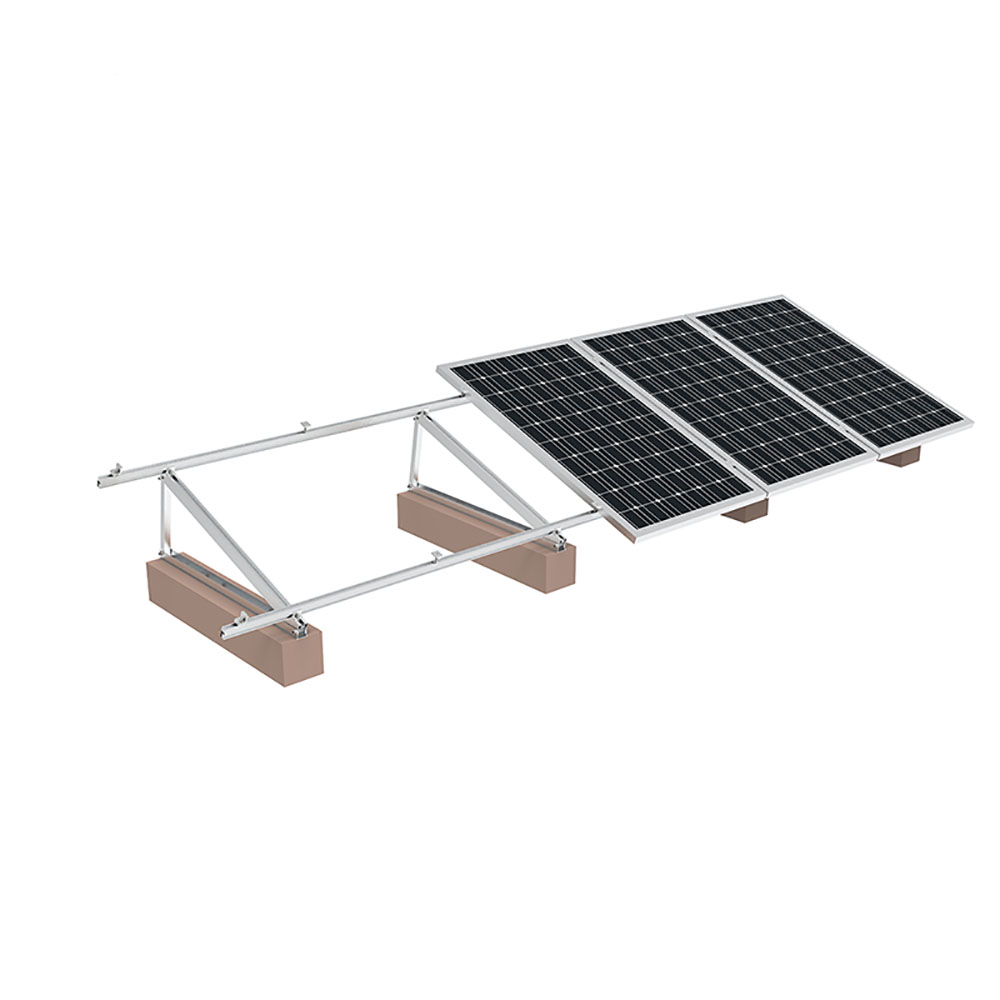
The NS-Roof Ballast-1 is a non-penetrating flat roof solar mount system in the solar roof ballast system category. Its structural configuration is a ballasted flat roof mounting system. It is designed for flat roof applications and commercial rooftop projects. The system uses weighted ballast instead of roof penetration, which helps protect the roof membrane and reduces leak risk associated with drilling.
The product is made of aluminium AL6005-T5 and stainless steel, with anodized aluminium components. It is available in silver, black, or customized colors. Its tilt angle range is 5° to 15°. The stated wind load is ≤60 m/s and the snow load is ≤1.4 kN/m². It carries a 10-year warranty and is CE certified. 9Sun Solar also notes that the system can be equipped with wind deflectors to reduce wind uplift forces and lower the required ballast weight; this should be confirmed in the project-specific ballast layout.
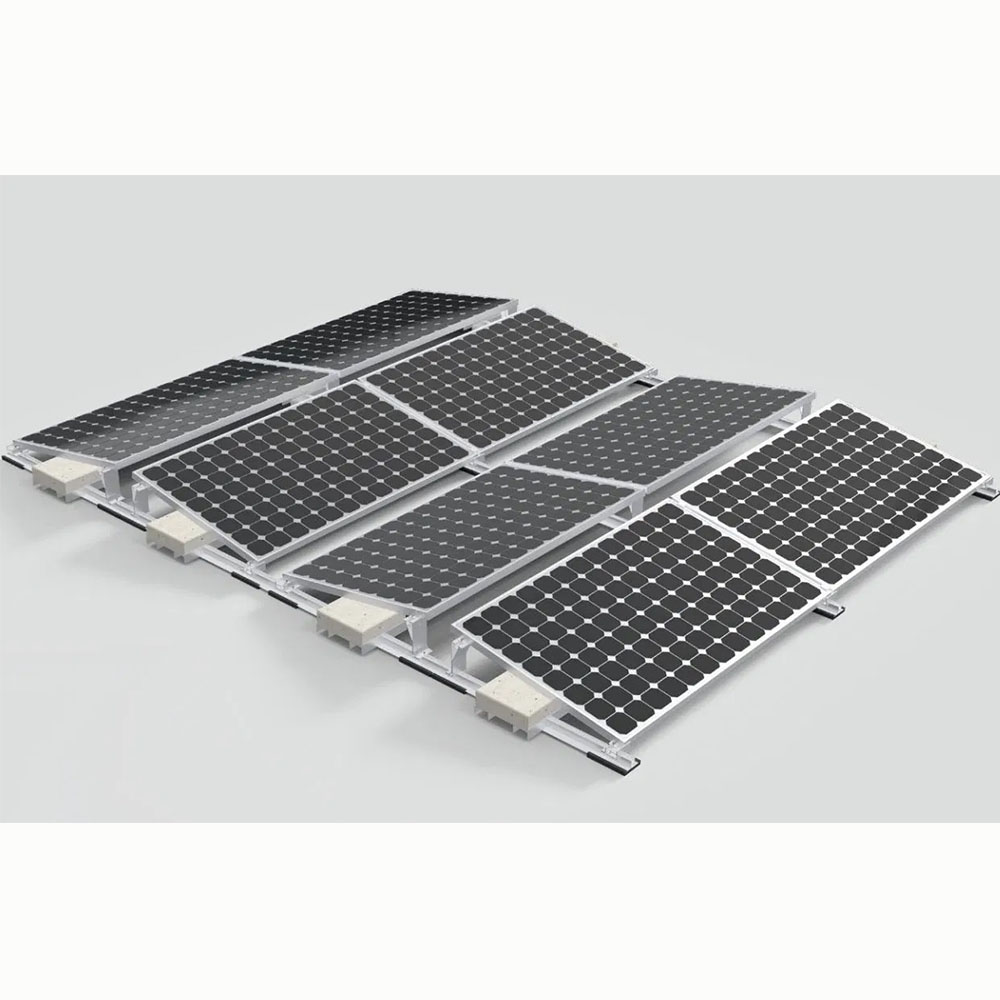
The limit is equally important: a ballasted system depends on the roof's load capacity and the project's wind uplift calculation. If the roof cannot accept the required ballast, the project may need a different fixing strategy. The NS-Roof Ballast-1 is therefore a strong discovery-stage option for flat roofs, but it is not a substitute for structural review.
2. NS-Roof Tripod-1: Adjustable Tilt for Roof Installation
The NS-Roof Tripod-1 is a solar roof tripod mounting system designed for roof installation scenarios. It is made of aluminium AL6005-T5 and stainless steel, available in silver, black, or customized colors, and is CE certified. Its tilt angle range is 0° to 60°, which gives designers more freedom to set the module angle than a fixed low-tilt ballast layout.
The product is described as a non-penetrating design that eliminates roof penetration and associated leak risk. It is intended for quick installation and lower labor time, and the system can be reconfigured or expanded for future solar array changes. Its stated wind load is ≤60 m/s and snow load is ≤1.4 kN/m², with a 10-year warranty.
3. NS-Adjustable Leg-1: Modular Flat and Slightly Pitched Roof Bracket
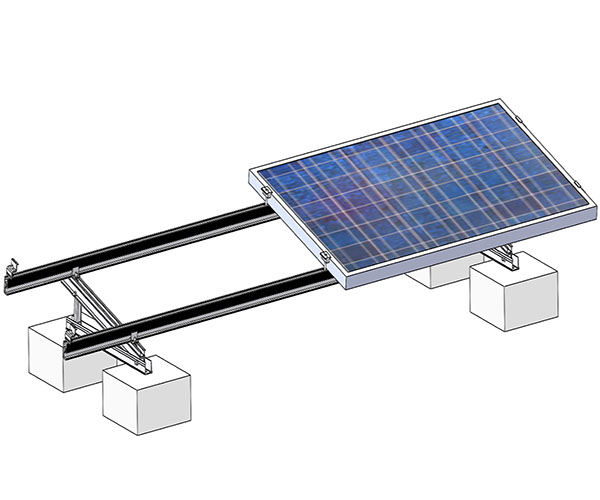
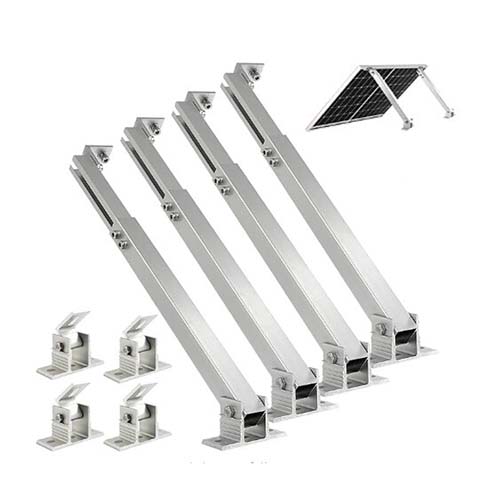
The NS-Adjustable Leg-1 is a solar adjustable leg bracket system for flat roof and slightly pitched roof solar mounting scenarios. It is intended for residential, commercial, industrial, public, and infrastructure solar projects. The product is made of aluminium AL6005-T5 with stainless steel components and anodized aluminium parts. It is available in silver, black, or customized colors and is CE certified.
This system uses a modular design. It includes expansion bolts for concrete roof surfaces and L-feet for metal roof foundation options, so the fixing method changes with the roof surface. The leg assemblies are pre-assembled before shipping. Its adjustable tilt range is 10° to 30°, with a stated wind load of ≤60 m/s and snow load of ≤1.4 kN/m². The warranty is 10 years.
Step-by-Step Breakdown: How to Evaluate a Flat Roof Solar Mount System
The following sequence keeps a flat roof project grounded in verified product facts and project-specific engineering. It is suitable for installers, EPC teams, distributors, and procurement teams in the awareness and research stages.
- Confirm the roof surface and slope. Identify whether the roof is concrete, metal, or membrane, and whether it is truly flat or slightly pitched. The NS-Adjustable Leg-1, for example, is designed for flat or slightly pitched roofs and supports concrete and metal roof surfaces with different foundation options.
- Set the tilt strategy. Compare the required angle with the product range. The NS-Roof Ballast-1 covers 5° to 15°, the NS-Adjustable Leg-1 covers 10° to 30°, and the NS-Roof Tripod-1 covers 0° to 60°. The chosen angle affects row spacing, wind exposure, and energy yield.
- Check structural load and wind uplift. Product ratings such as ≤60 m/s wind load and ≤1.4 kN/m² snow load are starting points. The project engineer should confirm ballast weight, fixing pull-out, roof capacity, and local load factors.
- Choose non-penetrating or mechanical fixing. Use a non-penetrating ballast approach only when the roof structure and waterproofing strategy support it. Where mechanical fixing is required, confirm the base detail, seal, and corrosion protection.
- Review material and corrosion protection. The 9Sun Solar flat roof options use AL6005-T5 aluminum alloy, stainless steel components, and anodized aluminium surfaces. Confirm that the grade and finish match the site's humidity, salt, and pollution exposure.
- Plan grounding and cable management. Solar mounting structures should provide a reliable grounding path for electrical safety. Coordinate the mounting layout with the electrical single-line diagram and local permitting checklist.
- Request drawings, certificates, and samples. Ask for product drawings, tilt and load data, CE documentation where applicable, warranty terms, and a sample or mock-up for review before purchase.
- Confirm delivery and installation sequence. Pre-assembled and modular components reduce roof time. 9Sun Solar states that production at the earliest could be completed within one week after receiving orders; actual lead time depends on configuration and order volume.
Use Cases: Where Flat Roof Mounting Systems Fit
Flat roof solar mount systems are used where the roof is low-slope and the project needs a controlled tilt and load path. The 9Sun Solar product data identifies several fitting scenarios:
- Commercial rooftop solar projects: The NS-Roof Ballast-1 and NS-Adjustable Leg-1 are both described as suitable for commercial rooftop solar projects. Ballast is often considered where penetration must be avoided; adjustable legs are used where the roof surface and fixing method allow a modular bracket layout.
- Residential flat and slightly pitched roofs: The NS-Adjustable Leg-1 is intended for residential, commercial, industrial, public, and infrastructure solar installations, including flat or slightly pitched roofs.
- Public and infrastructure rooftops: The same product families are intended for public and infrastructure applications, where documentation and long-term maintenance access often matter.
- Projects needing adjustable tilt: The NS-Roof Tripod-1 provides a 0° to 60° tilt range and is designed for roof installation scenarios, making it relevant when the module angle must be tuned or the array may be reconfigured later.
Comparison Table: 9Sun Solar Flat Roof Mounting Options
The table below uses product facts from 9Sun Solar's flat roof product data. It is a screening aid, not a substitute for project engineering.
| Feature | NS-Roof Ballast-1 | NS-Roof Tripod-1 | NS-Adjustable Leg-1 |
|---|---|---|---|
| Mounting principle | Ballasted, non-penetrating flat roof mounting system | Roof tripod mounting system; non-penetrating design described | Adjustable leg bracket system with modular design |
| Tilt angle | 5° to 15° | 0° to 60° | 10° to 30° |
| Material | Aluminium AL6005-T5 and stainless steel | Aluminium AL6005-T5 and stainless steel | Aluminium AL6005-T5 and stainless steel |
| Surface treatment | Anodized aluminium | Anodized aluminium | Anodized aluminium |
| Wind load | ≤60 m/s | ≤60 m/s | ≤60 m/s |
| Snow load | ≤1.4 kN/m² | ≤1.4 kN/m² | ≤1.4 kN/m² |
| Certification | CE | CE | CE |
| Warranty | 10 years | 10 years | 10 years |
| Typical fit | Flat roof applications and commercial rooftop projects | Roof installation scenarios requiring adjustable tilt | Flat or slightly pitched roofs; concrete and metal roof surfaces |
Color options for all three product families include silver, black, or customized colors. The product data also lists pre-assembled and modular features for the adjustable leg system, and a high degree of pre-assembly for the ballast system. These features matter at the research stage because they affect installation labor, roof access time, and the number of loose components handled on site.
FAQ: Flat Roof Solar Mount System Questions
What certifications and standards should buyers check for a flat roof solar mount system?
Check the certificate scope for the exact model and the standards required in the destination market. 9Sun Solar lists CE certification for the flat roof products covered here. For North America, UL 2703 is the safety standard for PV mounting systems. In addition, project submittals may require structural calculations, electrical calculations, and a single-line diagram. A City of Menifee, California example for PV ground-mount submittals requires complete electrical calculations and a single-line diagram including the solar PV panel. Buyers should request certificate-level evidence rather than relying on a general compliance claim.
How should buyers evaluate China solar mount system manufacturers for flat roof projects?
Evaluate product scope, factory facts, standards, warranty, and documentation. Xiamen 9Sun Solar Technology Co., Ltd. was founded in 2018 and operates its own factory in Quanzhou, Fujian, covering 500,000 m², with about 28 employees and an R&D team of seven engineers. The company reports a 2 GW annual production capacity for solar mounting systems and states that production follows GB/T 5237, Japan (JIS), and America (AA) standards. Its export ratio is stated as 99%, with markets including Japan, South Korea, the Philippines, Singapore, Armenia, Nigeria, Bulgaria, Cuba, Lebanon, Malaysia, Mongolia, Switzerland, Saudi Arabia, and Thailand. Confirm these company-reported facts against dated documents for your project.
What drives the budget for a flat roof solar mount system?
Budget is driven by the mounting principle, tilt range, material, roof fixing method, ballast requirement, project documentation, and order volume. A non-penetrating ballast system may reduce roof penetration work but can require ballast blocks and a structural check. An adjustable leg system uses modular parts and different foundation options for concrete or metal roofs. Published list prices are not provided in the available product data; request a project-specific quotation with drawings, bill of materials, and delivery terms.
Can I request a sample or project drawing before ordering?
Yes. For a flat roof project, request a product drawing, tilt and load data, material and finish details, and a sample or mock-up where available. 9Sun Solar provides a public product catalog and accepts project inquiries through its contact channels. A sample review is most useful when it is tied to the actual module size, roof surface, and fixing method.
What is the lead time for 9Sun Solar flat roof mounting systems?
9Sun Solar states that production at the earliest could be completed within one week after receiving orders. Actual lead time depends on the product family, configuration, quantity, and documentation requirements. For project planning, confirm the lead time in the quotation and align it with roof access, module delivery, and inspection dates.
Conclusion: Start with the Roof, Then Choose the Mount
A flat roof solar mount system should be chosen from the roof outward. First confirm the roof surface, load capacity, drainage, and penetration policy. Then select the mounting principle: non-penetrating ballast, tripod roof mounting, or adjustable leg brackets. Finally, verify the tilt range, material, corrosion protection, certification, warranty, and project documentation.
9Sun Solar's flat roof options give buyers a practical discovery set: the NS-Roof Ballast-1 for non-penetrating ballasted layouts, the NS-Roof Tripod-1 for a wide adjustable tilt range, and the NS-Adjustable Leg-1 for modular flat or slightly pitched roof mounting. Each product is supported by stated wind and snow ratings, CE certification, and a 10-year warranty, but each still requires project-specific engineering and confirmation.
Next Step: Review the Product Catalog or Request a Project Quote
For flat roof solar mount system selection, start with the product catalog, then send the roof type, module size, required tilt, wind and snow loads, and target market. 9Sun Solar can be contacted at exp@9sunsolar.com or through WhatsApp at +86 13599517330.
Product facts in this article are based on 9Sun Solar product data and company statements. Project approval, structural design, and certification scope must be confirmed for each installation.
Have Questions or Need More Details?
Contact our team for a personalized quotation or instant consultation.
Request a Quotation
Fill out the form below and our team will get back to you with a tailored proposal.
WhatsApp Direct Chat
Prefer to chat in real-time? Message us on WhatsApp for instant assistance & quick answers.
- Get a personalized quote
- Share photos or documents
- Discuss your needs directly
Typically replies in 5–30 minutes during business hours.