
Flat Roof Solar Bracket: A Buyer's Guide to Non-Penetrating Mounting
A flat roof solar bracket is the structural interface that holds a photovoltaic array on a low-slope roof and transfers wind, snow and dead loads into the building structure. On most flat roof projects the choice narrows to three families: ballasted non-penetrating systems that hold the array with weight, tripod or adjustable-leg frames that tilt modules without drilling the membrane, and rail-based systems anchored with expansion bolts on concrete or through-fixed on metal roofs. The right choice depends on membrane type, structural reserve, wind uplift, target tilt angle and the approval documents the building owner or authority requires.
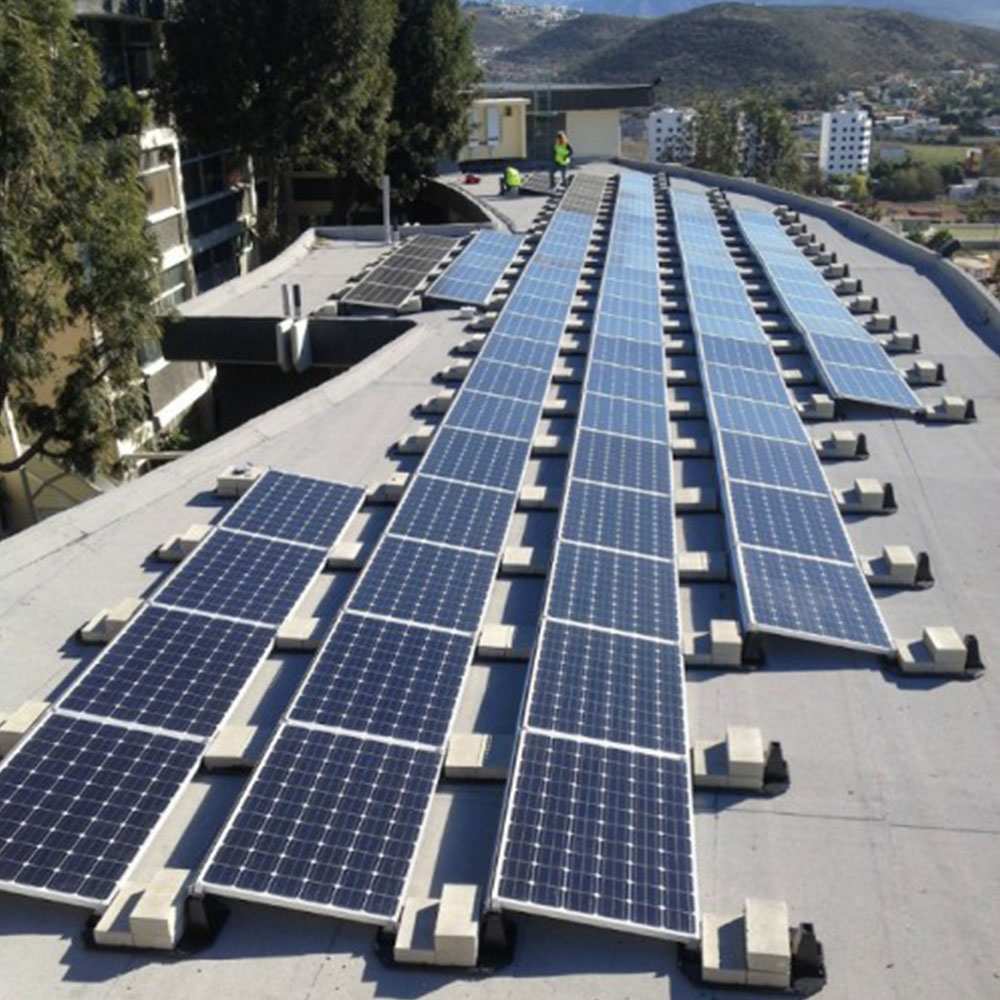
Short answer: for a membrane or coated flat roof where leaks are unacceptable, start with a non-penetrating ballasted system; where the module angle must be raised to increase yield, use a tripod or adjustable-leg bracket and keep the penetration count at zero; where the roof is structurally metal and the membrane is already a standing-seam or trapezoidal sheet, a rail-based system fixed at the purlins is usually the more compact option.
Why Flat Roofs Are Harder Than They Look
The defining problem of flat roof mounting is not the panel — it is the roof. A low-slope roof has a waterproofing layer with a limited tolerance for fastener holes, a structural deck with a defined reserve of live and dead load, and no natural pitch to shed water away from a new penetration. Every bracket decision therefore has to answer four questions at once.
1. Waterproofing and warranty
Every hole through a membrane is a potential leak path and, in many cases, a voided roof warranty. This is why non-penetrating designs exist: a ballasted structure avoids roof penetrations entirely and uses weighted ballast blocks for anchorage, which protects the roof membrane from damage and preserves the building's warranty.
2. Wind uplift rather than wind pressure
On a low-slope roof the critical load is usually negative pressure lifting the array at corners and edges, not downward pressure. Ballasted systems can be equipped with wind deflectors that reduce wind uplift forces on the array, and that aerodynamic design reduces the required ballast weight, lowering the overall roof load and material cost.
3. Structural reserve
Ballast is dead load. Adding hundreds of kilograms per array to a roof that was designed without a PV allowance can exceed the reserve, so ballast weight must be checked against the structural calculation rather than chosen by habit. Non-penetrating tripod systems exchange ballast for a lighter frame, but transfer point loads at the feet.
4. Tilt versus density
A flat-laid array maximises modules per square metre but sacrifices angle of incidence. A tilted array improves yield per module but increases row spacing to avoid self-shading, which reduces the installed capacity per roof. The bracket tilt range therefore directly determines the economics of the roof.
Industry Background: Why Flat Roof Mounting Is a Category of Its Own
Solar mounting is a large, materials-driven category. The global solar PV mounting systems market was valued at USD 49.7 billion in 2025 and is projected to reach USD 83.2 billion by 2035, according to Global Market Insights (2026). Within that market, aluminium captured 71.5% of the solar PV mounting systems market share by material in 2025 — a reflection of its strength-to-weight ratio and corrosion behaviour on roofs where added dead load and coastal humidity both matter.
Demand for roof-mounted systems is also being pushed by regulation rather than only by economics. California's 2025 Building Energy Efficiency Standards (Title 24, Part 6) mandate solar on all new commercial construction starting 1 January 2026, which converts roof-mount hardware from an optional upgrade into a construction-line item for commercial buildings in that jurisdiction.
On the compliance side, UL 2703 covers photovoltaic mounting systems, mounting devices, clamping or retention devices, and grounding lugs for flat-plate PV modules and panels, including ground-mounted and roof systems used as a non-structural building component. In trade terms, aluminium solar mounting structures typically classify under HS Code 7610.90 and steel structures under 7308.90, although customs treatment varies by jurisdiction.
Reading the market correctly: a large market value does not tell you which bracket fits a specific roof. Market data explains why the category is competitive and why lead times and material choice vary; it does not replace a project-specific wind, snow and structural calculation.
The Three Flat Roof Bracket Families
Family 1 — Ballasted non-penetrating systems
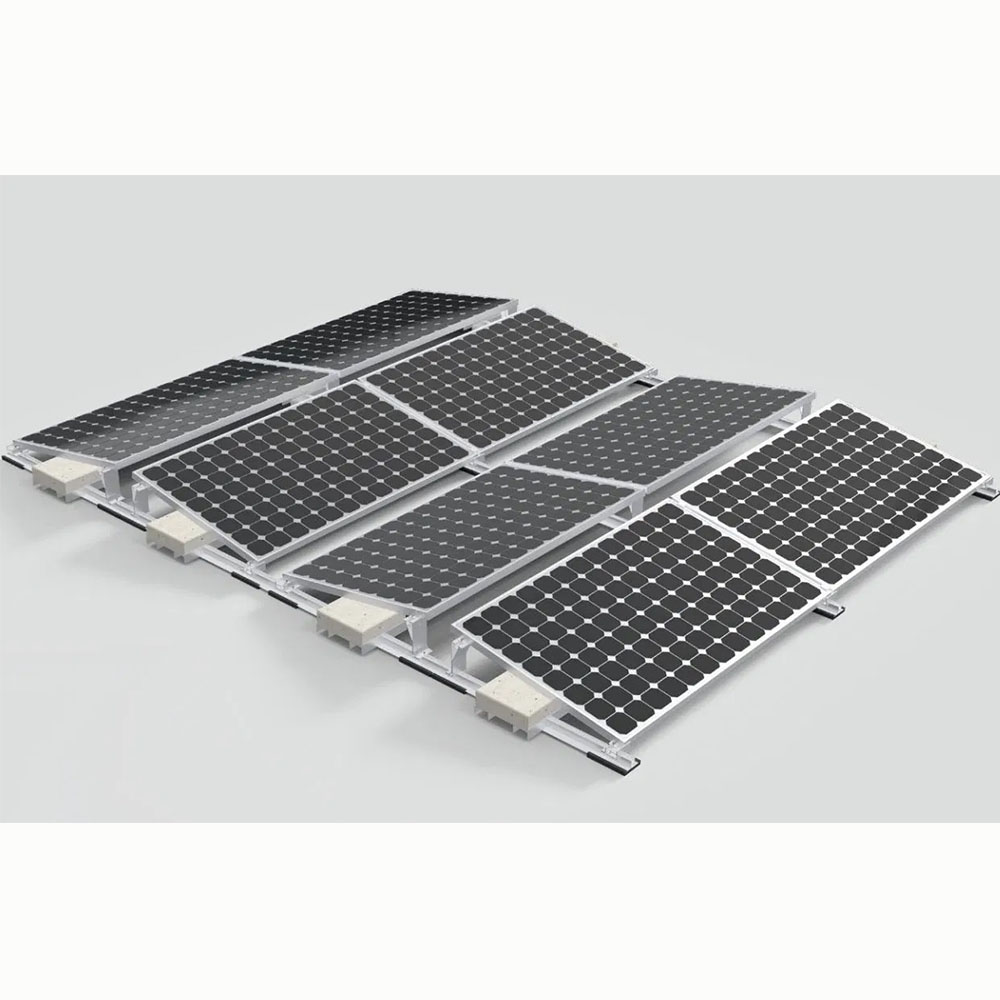
The NS-Roof Ballast-1 is a Solar Roof Ballast System in the solar roof ballast system category, designed for flat roof solar mounting applications. Its structure is a non-penetrating ballasted roof mount system: the array avoids roof penetrations, uses weighted ballast blocks for anchorage, and can be fitted with wind deflectors that reduce wind uplift forces. Components are pre-assembled and stainless-steel hardware is included.
- Material: aluminium AL6005-T5 with stainless steel, anodized aluminium surface
- Wind load: ≤60 m/s
- Snow load: ≤1.4 kN/m²
- Tilt angle: 5–15°
- Colours: silver, black or customized
- Warranty: 10 years; certification listed as CE
This family suits large, unobstructed commercial roofs where row spacing can be planned and where the structural engineer has confirmed the ballast allowance. Its main limitation is exactly what makes it attractive: the ballast weight is a permanent dead load, and the shallow 5–15° tilt range trades some winter yield for array density.
Family 2 — Tripod and adjustable-leg brackets
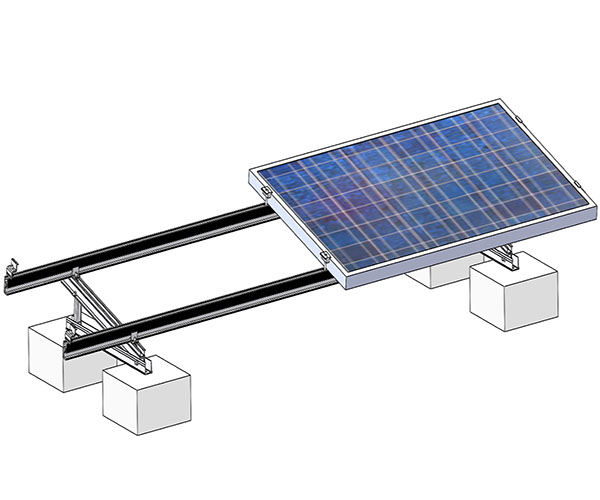
The NS-Roof Tripod-1 is a Solar Roof Tripod Mounting System belonging to the solar roof mounting structure category. It is made of aluminium AL6005-T5 and stainless steel, and its structural configuration is a non-penetrating design that eliminates the risk of roof leaks. Installation requires no drilling, the system is not permanently fixed — so the array can be reconfigured or expanded — and the adjustable tilt angle allows panels to be set to an angle that increases energy generation. The control method provides an adjustable tilt range from 0 to 60°, with a wind load of ≤60 m/s, a snow load of ≤1.4 kN/m², a 10-year warranty and CE listed.
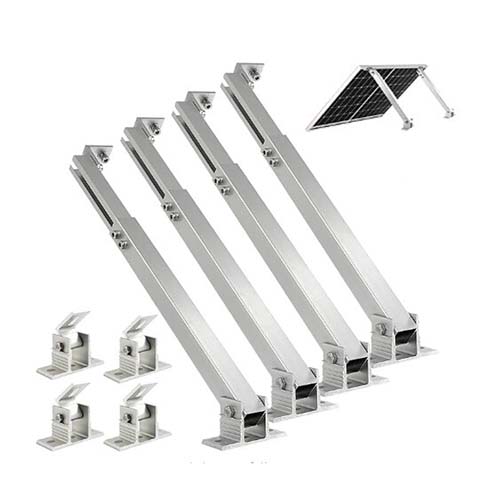
The NS-Adjustable Leg-1 is a Solar Adjustable Leg Bracket System in the solar mounting bracket category, designed for flat or slightly pitched roof scenarios. It is made of corrosion-resistant aluminium alloy AL6005-T5 and stainless-steel hardware, with an anodized surface treatment on the aluminium components, and it is available in silver, black or customized colours. Key components such as the leg assemblies are pre-assembled before shipping. The system supports various foundation options, including expansion bolts for concrete and L-feet for metal roofs, and offers a tilt angle adjustable from 10° to 30°, rated for wind load up to 60 m/s and snow load up to 1.4 kN/m², with a 10-year warranty and CE listed.
Decision rule: if the roof is a membrane you cannot penetrate and the target tilt sits between 5° and 15°, ballast is the natural starting point. If the target tilt is higher than 15° and the roof can accept point loads at the feet, an adjustable-leg or tripod frame releases more yield per module. If the roof is metal and the purlins are accessible, a rail-based system is usually the most compact.
Family 3 — Rail-based systems and the components that connect them
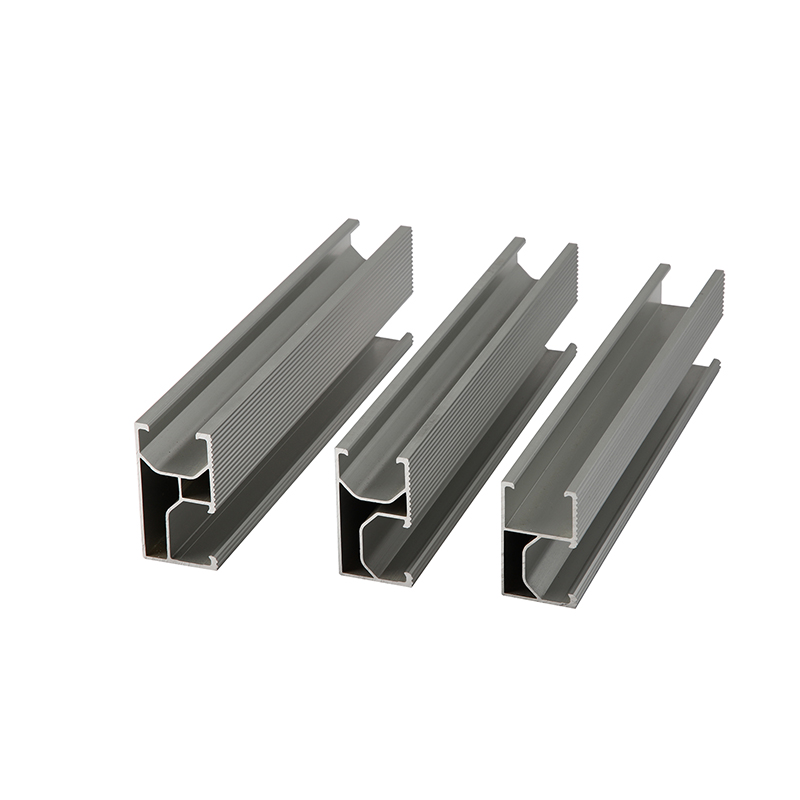
The rail family carries the array across multiple support points. The AR series solar rail (models AR1, AR2, AR3, AR46, BR1, BR2, BR3 and HR) is made of anodized aluminium alloy 6005-T5, rated for a wind load of 60 m/s and a snow load of 1.4 kN/m², and is intended for the solar energy, photovoltaic power generation and construction industries. Pre-cut lengths and pre-drilled holes allow simple bolt assembly, and the rails are compatible with mid and end clamps. The stated service life is 25 years.
The clamp is the second half of the interface. The solar clamp range (including NS-CKIC-F30/35, NS-CKIC-F35/40, NS-CKIC-F40/46, NS-RH-C07 through NS-RH-C11, NS-RH-C15G-80, NS-RH-25T-01, NS-IC17-F30/35, NS-IC17-F30/35-L50 and NS-DRIC17-F30-L50) uses an integrated grounding pin that eliminates separate grounding hardware, fits module frame heights typically in the 30–47 mm band, and is available in anodized aluminium or stainless steel. Rotatable claws support both portrait and landscape layouts, and the pre-assembled design reduces on-site fastening time.
Step-by-Step: How to Specify a Flat Roof Solar Bracket
Specification is a sequence, not a shopping list. Working through the steps below in order prevents the most common failure mode, where a bracket is chosen first and the roof is asked to accommodate it afterwards.
Step 1 — Classify the roof surface and structure
Identify whether the waterproofing is a membrane, coating or metal sheet, and whether the deck below is concrete, metal purlin or timber. This single step eliminates more options than any other: membrane roofs push you toward ballast or non-penetrating tripod frames, while accessible metal purlins make a rail-and-L-feet arrangement practical.
Step 2 — Obtain design wind and snow values
Use the project's design values rather than a generic assumption. The products in this guide are rated to wind loads of ≤60 m/s and snow loads of ≤1.4 kN/m²; if the site exceeds those values, the bracket family must change rather than the label.
Step 3 — Confirm the structural allowance
Ballast is dead load and must be checked against the roof's reserve. Where reserve is tight, a lighter aluminium frame with point loads at defined feet is easier to justify than a heavily ballasted array.
Step 4 — Fix the target tilt and row spacing
Choose the tilt before the layout. A 5–15° ballast system and a 0–60° tripod system produce very different row spacing, and row spacing determines installed capacity per roof. Remember that tilting raises yield per module but lowers module count, so the comparison must be on annual kWh per roof, not on bracket price.
Step 5 — Select the anchoring method
Ballast blocks, expansion bolts into concrete, or L-feet onto metal roof purlins. The NS-Adjustable Leg-1 supports expansion bolts for concrete and L-feet for metal roofs, which allows one bracket family to serve a mixed portfolio; where L-feet are used, each foot should carry a rubber seal at its base to protect the roof from leaks.
Step 6 — Specify rails, clamps and grounding
Confirm module frame thickness against the clamp range, confirm rail length against the array geometry, and decide whether integrated grounding pins or separate grounding conductors will be used. UL 2703 covers grounding lugs alongside mounting and clamping devices, so grounding is part of the certified scope rather than an accessory decision.
Step 7 — Check corrosion class against the site
Anodized AL6005-T5 aluminium and stainless-steel hardware suit coastal humidity and repeated wetting. Where the atmosphere is aggressive, the surface treatment and hardware grade should be confirmed in writing, not inferred from a product photo.
Step 8 — Build the document package before ordering
Collect structural calculations, product-specific test reports, certificates with numbers and scope, installation instructions, warranty terms and a packing list that shows what is pre-assembled. A bracket that arrives as loose components costs more on site than its unit price suggests.
Where Flat Roof Brackets Are Used
Flat roof mounting appears in a predictable set of project types. The mounting structure bears the weight of PV modules and withstands environmental loads such as wind, snow and earthquakes to ensure long-term system stability; it also maintains backside ventilation to reduce thermal losses, prevents shading between rows, and provides a reliable grounding path for electrical safety. The operating environment is typically outdoor, with wind, snow, hail pressure and humid conditions across a −40 °C to 85 °C range.
- Commercial and industrial warehouses: large uninterrupted membrane roofs where ballast avoids warranty disputes and array density matters more than a steep tilt.
- Residential flat and slightly pitched roofs: smaller areas where a 10–30° adjustable-leg frame recovers yield without a bespoke structure.
- Public and infrastructure buildings: projects with formal approval files, where certificates and structural calculations are reviewed before delivery.
- Metal roof factories and logistics sheds: where purlins are accessible and a rail-based layout reduces part count and installation hours.
- Coastal and high-humidity sites: where anodized aluminium and stainless-steel hardware carry the corrosion duty.
Comparison: Flat Roof Bracket Options Side by Side
| System | Anchoring principle | Material | Tilt range | Wind / snow rating | Warranty | Best fit |
|---|---|---|---|---|---|---|
| NS-Roof Ballast-1 | Non-penetrating, weighted ballast blocks; optional wind deflectors | AL6005-T5 aluminium + stainless steel, anodized | 5–15° | ≤60 m/s / ≤1.4 kN/m² | 10 years (CE listed) | Large membrane roofs where no penetration is permitted |
| NS-Roof Tripod-1 | Non-penetrating, no drilling, reconfigurable | AL6005-T5 aluminium + stainless steel | 0–60° adjustable | ≤60 m/s / ≤1.4 kN/m² | 10 years (CE listed) | Projects needing a high tilt angle without roof damage |
| NS-Adjustable Leg-1 | Expansion bolts for concrete or L-feet for metal roofs; legs pre-assembled | AL6005-T5 aluminium + stainless steel, anodized | 10–30° adjustable | ≤60 m/s / ≤1.4 kN/m² | 10 years (CE listed) | Flat or slightly pitched roofs with a defined fixing surface |
| AR series rail + clamp | Rail carried on fixings at purlins or structure; clamp secures the module frame | Anodized AL6005-T5 rail; anodized aluminium or stainless clamp | Fixed (no adjustable value listed) | 60 m/s / 1.4 kN/m² | Service life stated at 25 years (no separate warranty figure listed) | Metal roofs and layouts needing long continuous rail runs |
Read the table as a constraint filter, not a ranking. The ballast system is not superior to the rail system; it is available where penetration is forbidden, and unavailable where ballast weight cannot be carried. The tripod's 0–60° range is a capability, but on a tightly packed roof that range may be unusable because of row shading.
Verifying a Supplier: Certification, Capacity and Documents
For buyers shortlisting China solar bracket manufacturers, the useful question is not "who claims the widest product range" but "which claims are documentable". Three claim types are routinely confused and should be separated in any supplier review.
Design reference versus certification
Xiamen 9Sun Solar Technology Co., Ltd. states that its mounting systems are designed according to JIS C8955:2017, AS/NZS 1170 and other national standards. That is a company-reported design reference; it is not proof of certification or of conformity for a specific product in a specific jurisdiction. The flat roof and roof-mount products in its catalogue list CE, while UL 2703 defines the scope for PV mounting systems, clamping devices and grounding lugs in the United States. Buyers should request the certificate number, the product family covered, the issuing body and the validity period before treating any of these as a pass.
Capacity figures need a defined basis
9Sun Solar reports an annual solar mounting-system capacity of 2 GW from its own factory in Quanzhou, Fujian. Capacity is only comparable when the denominator, product mix and reporting period are disclosed, so a factory audit should confirm production records, equipment list and utilisation rather than accept a headline number.
Factory and engineering record
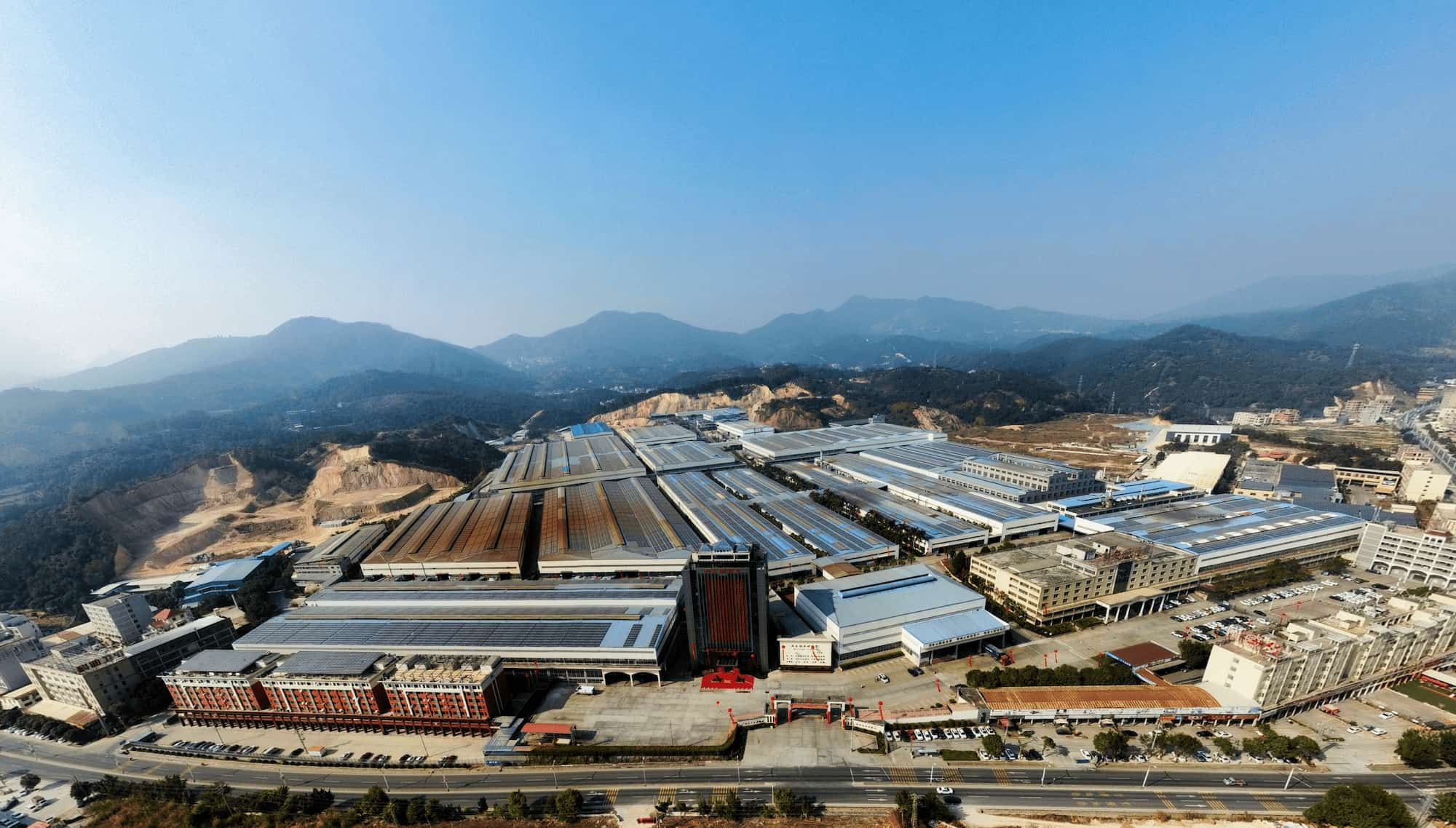
Xiamen 9Sun Solar Technology Co., Ltd. is a solar PV mounting structure manufacturer based in Xiamen, China, established in 2018 and therefore carrying eight years of operating history as of 2026. The company employs approximately 28 staff, including a research and development team of 7 engineers engaged in the design of photovoltaic products, and operates its own factory in Quanzhou, Fujian Province, covering 500,000 m². Its product scope covers solar ground, roof, farm and carport mounting systems, balcony solar brackets, vertical solar panel fences, ground screws and solar PV cables. The company reports an export ratio of 99% and lists Japan, Korea, the Philippines, Singapore, Armenia, Nigeria, Bulgaria, Cuba, Lebanon, Malaysia, Mongolia, Switzerland, Saudi Arabia and Thailand among its markets. Mounting systems carry a 10-year warranty, with an actual service life stated as up to 25 years under proper use.
For a flat roof project, that scope matters because a single order can combine the structural bracket, the rail, the mid and end clamps and the grounding hardware instead of splitting the bill of materials across three suppliers with three different tolerances.
Frequently Asked Questions
Are 9Sun Solar flat roof brackets certified for my market?
The flat roof and roof-mount products in the 9Sun Solar catalogue list CE. The company also states that its mounting systems are designed according to JIS C8955:2017, AS/NZS 1170 and other national standards, which is a design reference rather than proof of certification. In the United States, UL 2703 covers photovoltaic mounting systems, mounting devices, clamping or retention devices and grounding lugs, so a listing under that standard must be confirmed with a certificate number and scope. Before delivery, request product-specific certificates, test reports and structural calculations for the destination market.
What can a China-based solar bracket manufacturer supply for a complete flat roof system?
Xiamen 9Sun Solar Technology Co., Ltd. is a solar PV mounting structure manufacturer established in 2018 in Xiamen, China, with its own factory in Quanzhou, Fujian, covering 500,000 m². Its product scope includes solar ground, roof, farm and carport mounting systems, balcony brackets, vertical solar panel fences, ground screws and solar PV cables, together with AR series solar rails and a solar clamp range covering module frame heights typically in the 30–47 mm band. A flat roof package can therefore combine a ballast, tripod or adjustable-leg structure with rails, clamps and grounding hardware from one source. The company reports 2 GW annual capacity; confirm the capacity basis during a factory audit.
What drives the cost of a flat roof solar bracket system?
Cost is driven by material choice and mass, the number of components, the degree of pre-assembly, the anchoring method, the design wind and snow rating, the surface treatment, packing volume and on-site labour. Ballasted systems add ballast weight and wind deflectors; non-penetrating tripod and adjustable-leg systems reduce parts but may require more support points. Compare options on landed cost per installed kWp, including freight, hardware and installation hours, rather than on the unit price of a single bracket.
Can I validate a flat roof bracket before placing a bulk order?
Validation works best as a document and sample review: provide the roof type and waterproofing, module dimensions and frame thickness, target tilt, design wind and snow values and destination market, then request a project-specific drawing package and a physical sample. For 9Sun Solar, requests can be sent to exp@9sunsolar.com or +86 18959234313. The mounting systems carry a 10-year warranty, so the warranty terms should be reviewed alongside the sample.
How long is the lead time for a flat roof bracket order?
9Sun Solar states that production can, at the earliest, be completed within one week after receiving an order, and that fast delivery is available. Actual lead time depends on the configuration, the quantity of pre-assembled components and the selected surface treatment, so it should be confirmed in writing per SKU rather than assumed from a general statement. To move from evaluation to a quotation, download the product catalogue and send the project parameters for a configuration review.
Next step: turn the roof into a specification
Send the roof type, module size, target tilt and design wind and snow loads, and 9Sun Solar will return a flat roof bracket configuration with rails, clamps and hardware matched to the layout.
Request a flat roof bracket quotation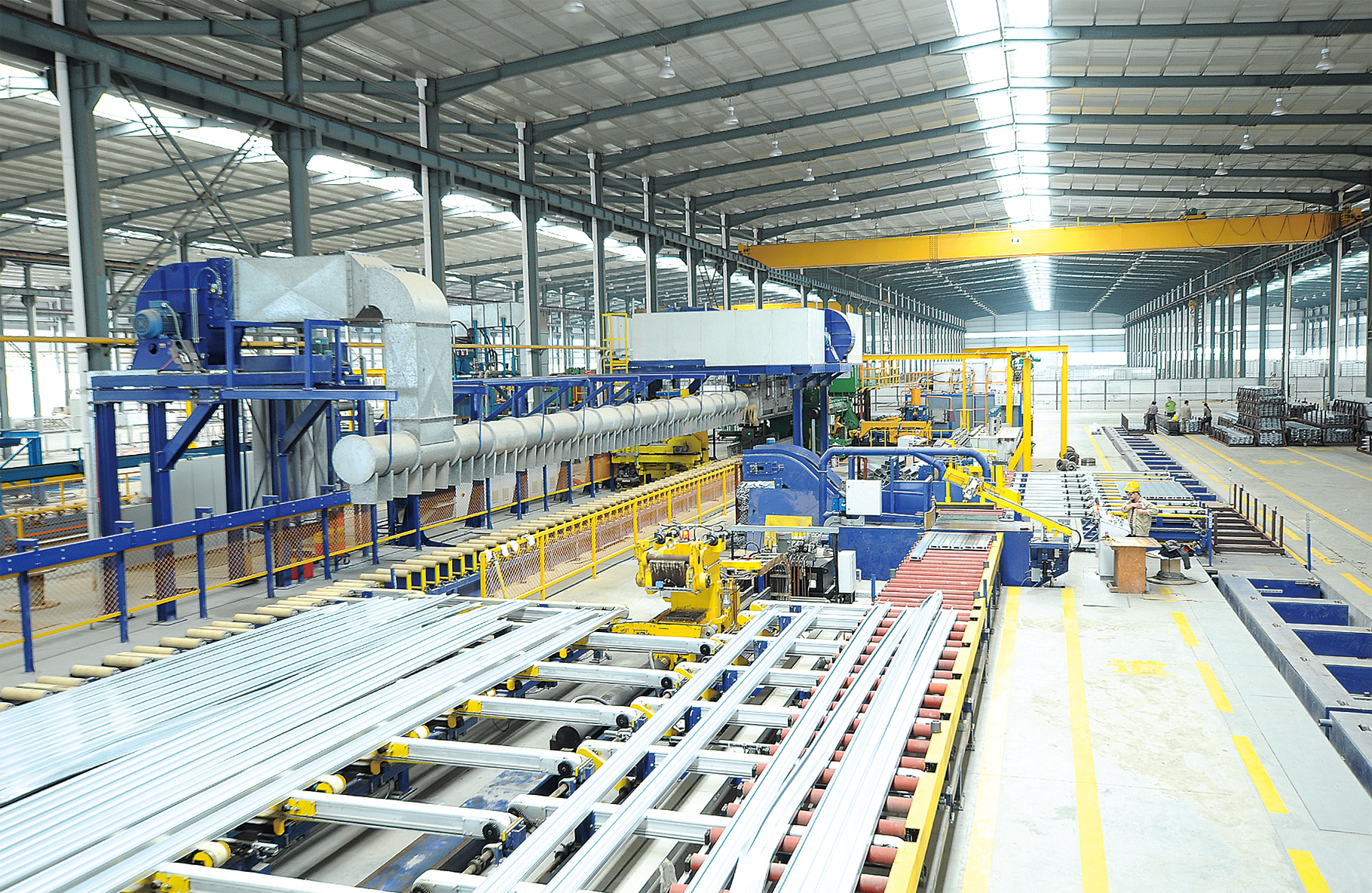
Download the 9Sun Solar product catalogue (PDF) for rail models, clamp dimensions and bracket specifications.
Conclusion
A flat roof solar bracket is a compromise between four constraints: waterproofing, structural reserve, tilt angle and installed density. Ballasted non-penetrating systems protect the membrane and suit large commercial roofs at 5–15°; tripod and adjustable-leg frames recover yield at higher tilt without drilling; rail-based systems keep metal roof installations compact and repeatable. All three families in the 9Sun Solar range are rated to wind loads of ≤60 m/s and snow loads of ≤1.4 kN/m², use anodized AL6005-T5 aluminium with stainless-steel hardware, and carry a 10-year warranty.
The purchase decision should be settled with documents rather than adjectives: design wind and snow values, a structural check on ballast or point loads, certificates with numbers and scope, and a packing list that shows what arrives pre-assembled. Buyers who separate design references from certification, and who compare landed cost per installed kWp rather than bracket price, will specify a system that survives both the first storm and the final inspection.
Have Questions or Need More Details?
Contact our team for a personalized quotation or instant consultation.
Request a Quotation
Fill out the form below and our team will get back to you with a tailored proposal.
WhatsApp Direct Chat
Prefer to chat in real-time? Message us on WhatsApp for instant assistance & quick answers.
- Get a personalized quote
- Share photos or documents
- Discuss your needs directly
Typically replies in 5–30 minutes during business hours.