How to Specify a Metal Roof Solar Bracket: Loads, Certification and Fixing Constraints
A metal roof solar bracket is not chosen by preference. It is chosen by constraint. Four constraints decide almost every outcome on a metal roof project: the roof profile and the exact point where the bracket is fixed, the design wind and snow loads at the site, the corrosion class of every component in the load path, and the certification evidence a buyer can hand to an inspector, a lender or a building owner.
Get those four right and the array performs as designed for its stated service life. Get one wrong and the failure mode is predictable — sheet distortion around a fixing, water ingress at a penetration, fretting at a clamp, or a completed installation that cannot be signed off at all.
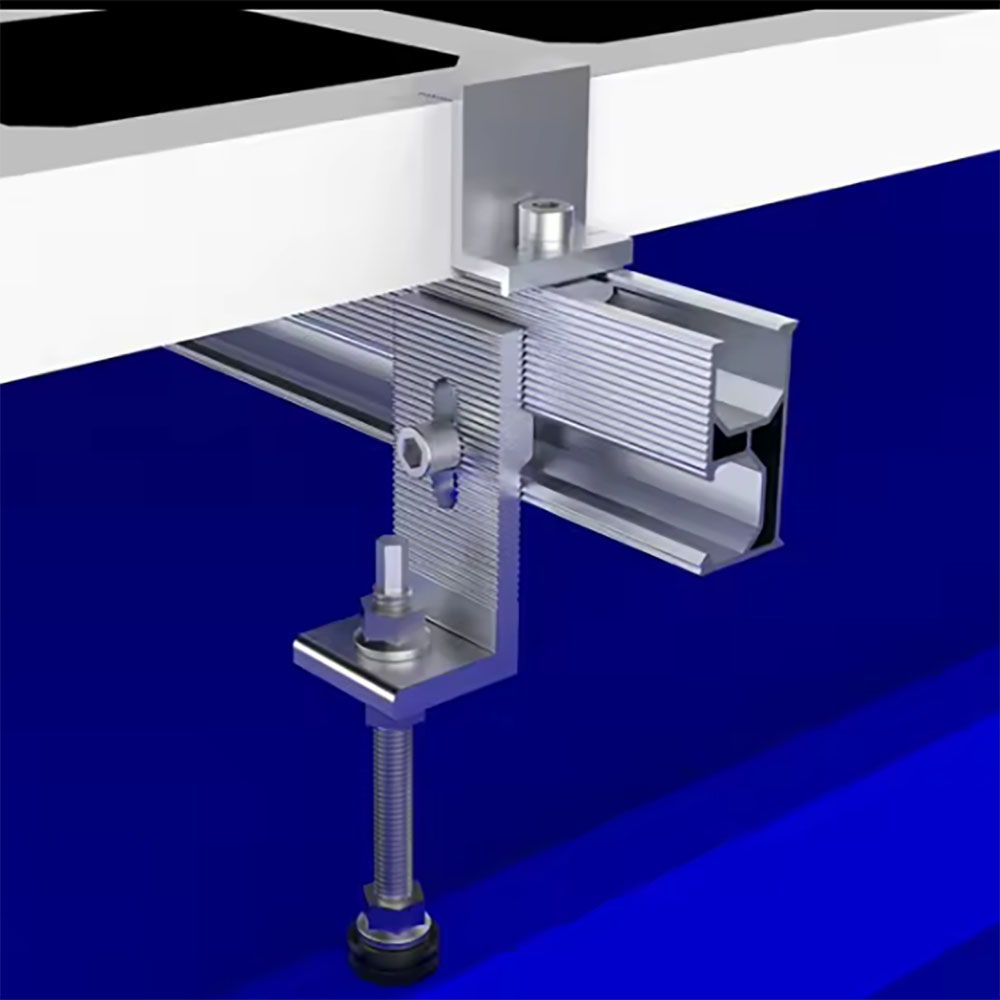
NS-tin roof-2 metal roof solar bracket, bolted through the roof sheet into the purlins.
The specification answer in one paragraph. A metal roof solar bracket for a commercial or industrial steel roof has to do three things at once: transfer uplift from the module frames into the purlins without deforming the sheet, keep every fixing watertight, and survive the local corrosion environment for 25 years. 9Sun Solar's metal roof systems — the NS-tin roof-2 direct-fix system and the NS-mini rail-1 low-profile rail system — are rated for wind loads up to 80 m/s and snow loads up to 150 cm, use anodized AL6005-T5 aluminium with stainless-steel hardware, and are listed with CE certification and a 10-year warranty.
Problem Definition: What Actually Fails on a Metal Roof
Most metal roof bracket problems trace back to a mismatch between the bracket and the roof it is bolted to, not to a defective part. The roof is a thin profiled sheet spanning between purlins. The bracket is a rigid aluminium component. Every load the array receives has to pass from one to the other through a small number of fixings.
Load path: sheet or purlin
The first decision is whether the bracket is fixed through the sheet into the structural purlin, or clamped onto the sheet profile only. Direct fixing into the purlins creates a short, stiff load path and is the approach used by the NS-tin roof-2 system, which bolts the L-feet through the roof sheets onto the main supports. Clamped connections avoid penetrations but depend entirely on the seam profile and the clamp design.
Uplift concentrates at the edges
Wind does not load an array evenly. Uplift peaks at the corners and the windward edge of the array, which is exactly where installers tend to place brackets at the standard spacing. A bracket rated for a high wind load is not a substitute for correct spacing at edge zones — both are needed.
Penetration is a warranty question, not just a leak question
A penetration that leaks six months after handover is expensive. A penetration that voids the roofing manufacturer's warranty can be more expensive still. Each L-feet in the NS-tin roof-2 system carries a rubber seal at its base to protect the roof from leaks, but the buyer still has to confirm that the roofing supplier accepts the penetration pattern being proposed.
Module frame height varies more than buyers expect
Module frames are not a single standard height. A clamp that fits one module batch may not seat correctly on the next delivery. 9Sun Solar's solar clamp range addresses this with a design that fits module frame heights typically between 30 mm and 47 mm, and with rotatable claws that support both portrait and landscape layouts.
Corrosion starts at the contact line
Where aluminium meets a coated steel sheet, and where a stainless bolt meets an aluminium rail, the contact line is where corrosion begins. Anodizing the aluminium, using stainless-steel hardware, and keeping dissimilar-metal contact under control matter more than the bulk material grade alone.
Industry Background: Why the Constraint Set Got Stricter
Three separate pressures have tightened metal roof bracket specification over the past two years: market scale, material preference, and regulation.
Scale. The global solar PV mounting systems market was valued at USD 49.7 billion in 2025 and is projected to reach USD 83.2 billion by 2035, according to Global Market Insights. A market of that size supports many suppliers, which raises the value of documentation rather than lowering it.
Material. Aluminium captured 71.5% of the solar PV mounting systems market share by material in 2025, again per Global Market Insights. The reason is practical: aluminium extrudes into the profiles that roof brackets need, anodizes predictably, and keeps weight off a roof structure that was not designed for extra dead load.
Regulation. In California, the 2025 Building Energy Efficiency Standards (Title 24, Part 6) mandate solar on all new commercial construction starting 1 January 2026, per the California Energy Commission. Mandates of this type push more arrays onto metal commercial roofs, and they push the compliance paperwork onto the supplier.
On the standards side, UL 2703 covers photovoltaic mounting systems, mounting devices, clamping or retention devices, and grounding lugs for flat-plate PV modules and panels, including ground-mounted and roof systems used as a non-structural building component — as described by UL Solutions. Buyers working in North America should read UL 2703 as a scope statement, not a marketing badge: it defines what has to be evaluated, and the certificate has to match the product family actually being shipped.
For procurement and customs purposes, solar mounting structures typically classify under HS code 7610.90 for aluminium and 7308.90 for steel. Classification still depends on the destination customs authority, but the codes are the usual starting point for a landed-cost model.
Detailed Solution: How 9Sun Solar Addresses the Metal Roof Constraints
Xiamen 9Sun Solar Technology Co., Ltd., trading as 9Sun Solar, is a solar mounting system manufacturer based in Xiamen, Fujian Province, China, founded in 2018, with its own production in Quanzhou, Fujian, and a reported export ratio of 99% across markets including Japan, South Korea, Singapore, the Philippines, Thailand, Saudi Arabia and Nigeria. Its product scope covers ground, roof, farm, carport and balcony mounting systems, with an OEM/ODM production mode.
For metal roofs specifically, the relevant products are the NS-tin roof-2 solar tin roof mount system, the NS-mini rail-1 solar tin roof mini rail system, and the solar rail and clamp components that complete the assembly.
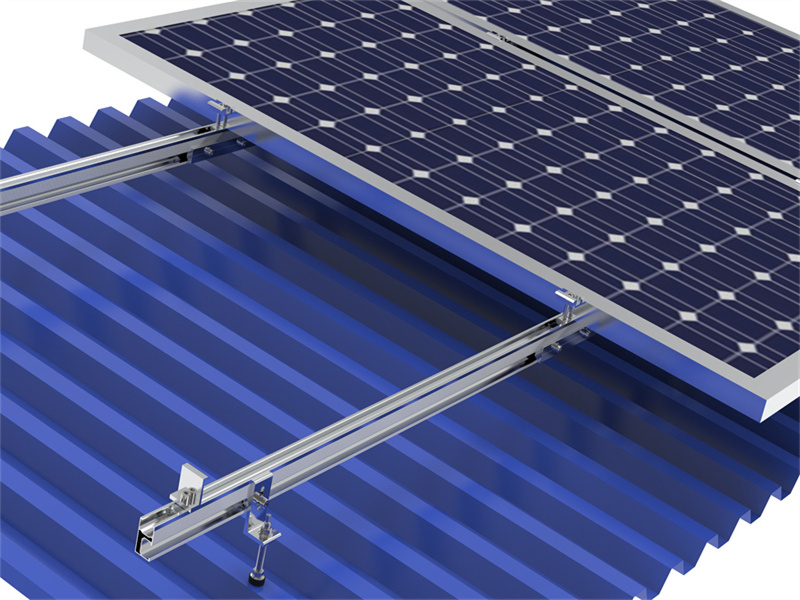
Metal roof mounting assembly: L-feet transfer load into the purlins, rails carry the module rows.
NS-tin roof-2: the direct-fix baseline
The NS-tin roof-2 system fixes L-feet directly onto the metal roof's main supports through the roof sheets. That creates a strong, direct and simple connection — the load path is short and the fixing count is predictable. The frame material is aluminium AL6005-T5 with stainless-steel hardware, the aluminium is anodized, and each L-feet carries a rubber seal at its base to protect the roof from leaks. Published ratings are a wind load of ≤80 m/s and a snow load of ≤150 cm, with a 10-year warranty and a choice of silver, black or customized colours. The system is listed with CE certification.
NS-mini rail-1: the low-profile alternative
Where the design allows a shorter rail, the NS-mini rail-1 uses less aluminium, which makes the system lighter and more cost-effective without changing the stated ratings. Smaller rails are easier for a single installer to handle and manoeuvre on the roof, and the reduced part count shortens installation time. The profile also sits closer to the roof, giving a cleaner finish. Ratings match the standard system at ≤80 m/s wind and ≤150 cm snow, with a 10-year warranty and CE certification.
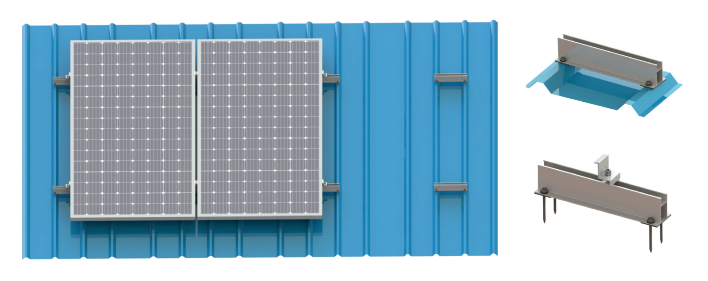
NS-mini rail-1 reduces aluminium content and part count on metal roof arrays.
Rails and clamps: where the module actually sits
The rail and clamp set the module plane and transfer module loads into the bracket. 9Sun Solar's solar rail is made of anodized aluminium alloy 6005-T5 with a wind load rating of 60 m/s and a snow load rating of 1.4 kN/m². The matching solar clamp is also AL6005-T5 with an anodized surface, rated at 60 m/s wind and 1.4 kN/m² snow, and adds two features that matter on a roof: an integrated grounding pin that removes separate grounding hardware, and a pre-assembled design that speeds up the work and lowers labour cost. One clamp fits module frame heights typically between 30 mm and 47 mm, which reduces the number of SKUs a distributor has to stock.
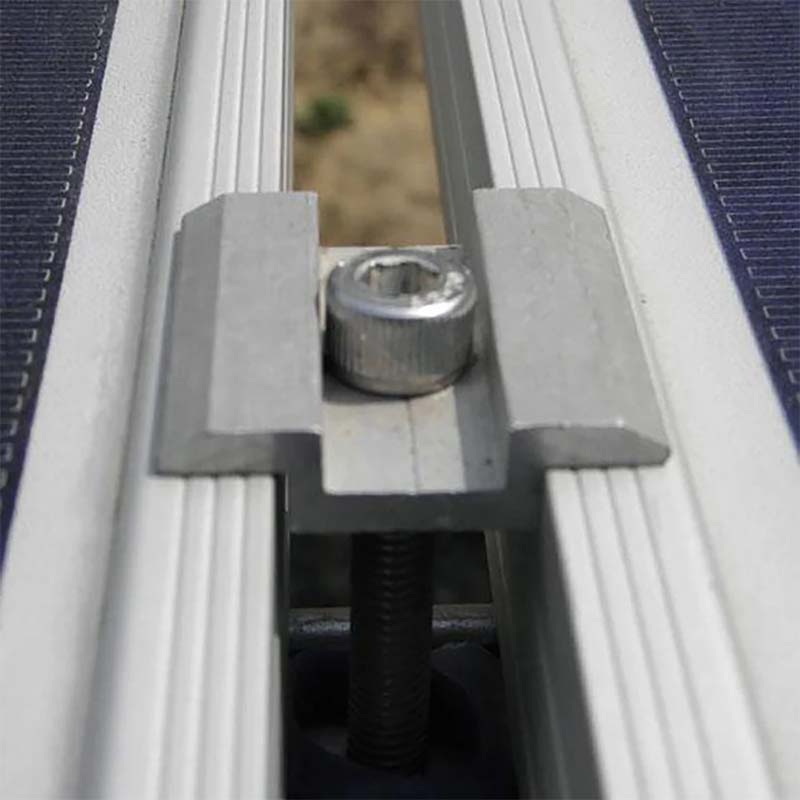
NS-CKIC-F30/35 mid clamp: AL6005-T5, anodized, integrated grounding pin.
Adjacent systems buyers often price in the same RFQ
Metal roof projects rarely exist alone. The same buyer usually needs the neighbouring product families: the NS-Roof Tripod-1 with an adjustable tilt range of 0° to 60°, the NS-Roof Ballast-1 non-penetrating flat roof system with a 5° to 15° tilt, the NS-Adjustable Leg-1 with a 10° to 30° adjustable tilt, and the NS-Balcony-1 with a 15° to 25° tilt. All four carry CE certification and a 10-year warranty, with wind ratings of 60 m/s or 80 m/s depending on model.
Step-by-Step: Specifying a Metal Roof System
Step 1 — Identify the roof profile and the fixing point
Record the sheet profile, the sheet thickness, the purlin spacing and the purlin material. Decide whether the bracket will be bolted through the sheet into the purlins, as with the NS-tin roof-2 L-feet, or clamped to the seam. This single decision determines which product family is even applicable.
Step 2 — Establish design wind and snow loads
Obtain the site design values from the project engineer, including edge and corner zones. Then compare them to the published rating. For the NS-tin roof-2 and NS-mini rail-1 systems the published ratings are ≤80 m/s wind and ≤150 cm snow, and for the rail and clamp assembly 60 m/s and 1.4 kN/m². A product rating is a ceiling, not a design calculation — the bracket spacing at edge zones still has to be worked out for the site.
Step 3 — Choose the rail architecture
Full rail suits longer spans, heavier snow and larger arrays. Mini rail suits shorter spans and projects where weight, material cost and installation speed dominate. Both 9Sun Solar options carry the same published wind and snow ratings, so the decision is about geometry, load distribution and labour, not about one being stronger.
Step 4 — Confirm module frame compatibility
Check the module frame height against the clamp range. The 9Sun Solar clamp family covers frame heights typically between 30 mm and 47 mm, and the rotatable claws support both portrait and landscape layouts. Confirm the clamp model against the actual module datasheet, not against the previous project's module.
Step 5 — Fix the corrosion class
Match the finish to the environment. Anodized AL6005-T5 aluminium with stainless-steel hardware is the baseline for metal roof systems. Where steel components are used nearby, project specifications commonly call for hot-dip galvanizing of at least 65 μm, and for proven resistance to salt spray, ammonia and UV over a 25-year service life. Coastal, industrial and agricultural sites should all be reviewed against those criteria rather than against a generic corrosion claim.
Step 6 — Verify the certification file, not the logo
Ask for the certificate documents and check that the product family on the certificate matches the product being ordered. 9Sun Solar's file includes a CE Attestation of Conformity, certificate number PRSZ23120603CR, issued by PISI on 2023-12-12 for the EU market under RoHS Directive 2011/65/EU for the NS-Solar Tile Roof-1 product. Separately, 9Sun Solar states that its mounting systems are designed with reference to JIS C8955:2017 and AS/NZS 1170. A design reference is not a certificate; both should be requested, and the difference should be understood before the file goes to an authority having jurisdiction.
Step 7 — Confirm tolerance, packaging and delivery
Installation tolerances matter more than they look. Project specifications commonly require tilt angle deviation within ±1°, and working conditions of -40 °C to 85 °C should be checked against the site. On delivery, 9Sun Solar lists a minimum order quantity of 1000 watts, production that can be completed within 7 days of order receipt at the earliest, monthly capacity of 170 MW, 100% testing, and remote after-sales support with a 10-year warranty.
Comparison Table: Metal Roof Bracket Options from 9Sun Solar
The table below compares the two metal roof systems against the rail-and-clamp assembly that completes both. Every value is a published product specification.
| Specification | NS-tin roof-2 solar tin roof mount system | NS-mini rail-1 solar tin roof mini rail system | Solar rail + solar clamp assembly |
|---|---|---|---|
| Fixing method | L-feet bolted through the roof sheet to the purlins, rubber seal at base | Low-profile mini rail, smaller footprint, reduced part count | Rail carries modules; clamp secures module frames to rail |
| Primary material | Aluminium AL6005-T5, stainless steel | Aluminium AL6005-T5, stainless steel | Anodized aluminium alloy 6005-T5 |
| Surface treatment | Anodized | Anodized | Anodized |
| Wind load rating | ≤80 m/s | ≤80 m/s | 60 m/s |
| Snow load rating | ≤150 cm | ≤150 cm | 1.4 kN/m² |
| Certification | CE | CE | Component-level, supplied with the certified system |
| Warranty | 10 years | 10 years | Covered by system warranty |
| Colour | Silver, black or customized | Silver, black or customized | Silver (anodized) |
| Typical fit | Longer spans, higher snow, larger arrays | Shorter spans, weight-sensitive roofs, fast installation | Module plane and frame-height compatibility |
Published ratings for 9Sun Solar metal roof products. Ratings are design ceilings; site-specific structural calculation remains the buyer's responsibility.
Use Cases: Metal Roof Projects Already Running
Ratings and certificates describe what a system should do. Installed projects describe what it has done.
A 2.5 MW roof solar project delivered to a South Korean solar installer using the NS-tin roof-2 system has been in stable operation for two years. A 998 kW roof project for another South Korean installer, also on the NS-tin roof-2, has been running for five years. A 522 kW roof project for a third South Korean installer has been in stable operation for six years.
In Singapore, a 1.8 MW roof project and a 2 MW roof project, both using the NS-tin roof-2 system, have each been in stable operation for two years. Across these installations the recurring requirement was the same: a fixing method that could be executed on an existing metal roof without disrupting the building's operation, and a documented load rating that satisfied the project's structural reviewer.
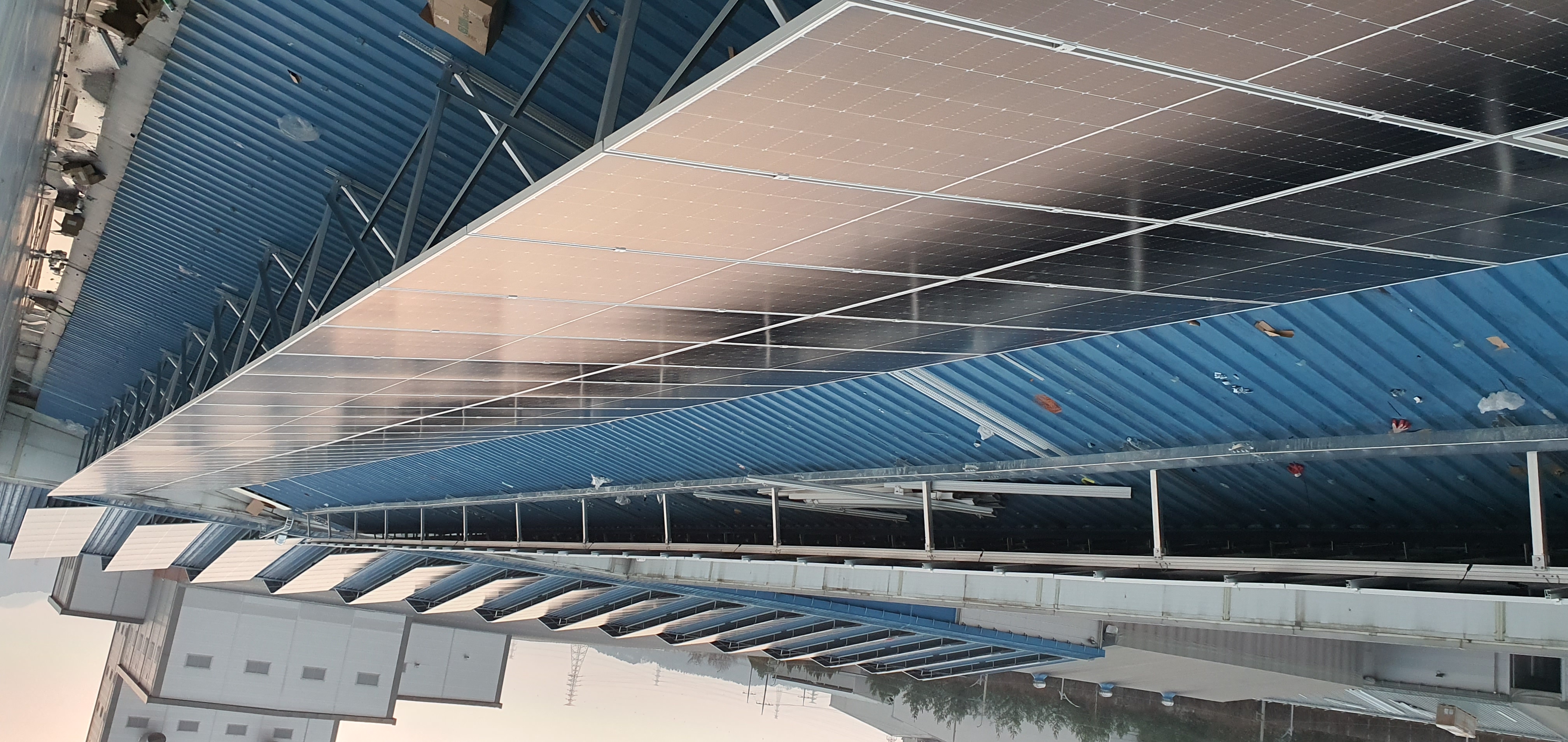
2.5 MW roof project, South Korea: NS-tin roof-2 metal roof system, in stable operation since commissioning.
Behind those projects sits a production base with automatic extrusion, vertical oxidation, powder coating and fluorocarbon painting lines. Buyers who audit a supplier before placing a repeat order usually start there, because extrusion and anodizing control the two variables that decide whether a metal roof bracket performs in year fifteen: profile tolerance and coating consistency.
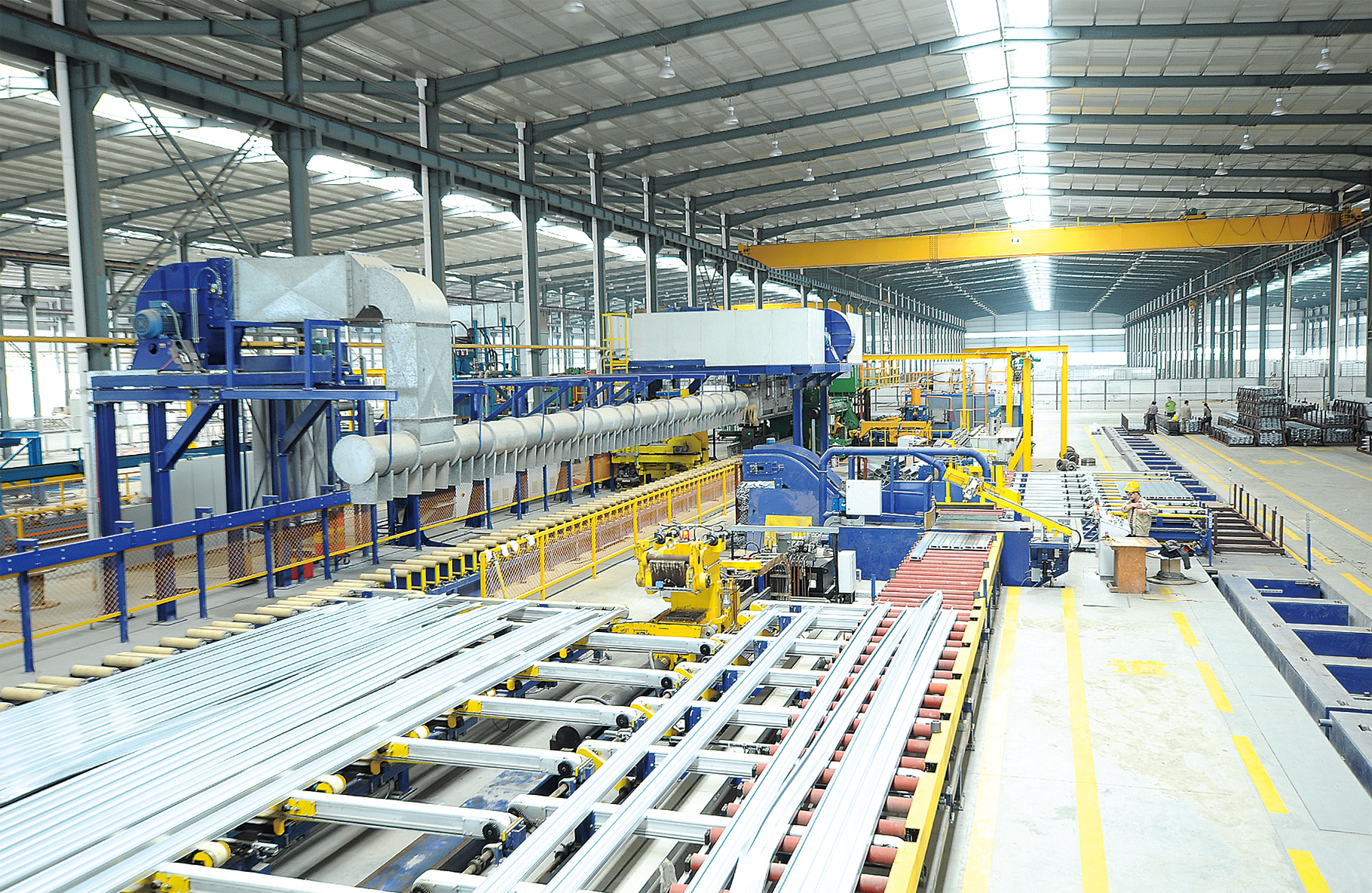
Automatic extrusion line: profile tolerance and anodizing consistency start here.
FAQ: Metal Roof Solar Bracket Constraints
1. What certification should a CE certified solar bracket manufacturer provide for a metal roof project?
Ask for the certificate document, not a logo on a datasheet. 9Sun Solar's file includes a CE Attestation of Conformity, certificate number PRSZ23120603CR, issued by PISI on 2023-12-12 for the EU market under RoHS Directive 2011/65/EU; that document is recorded against the NS-Solar Tile Roof-1 product. The NS-tin roof-2 and NS-mini rail-1 metal roof systems are separately listed with CE certification. For North America, UL 2703 covers mounting systems, mounting devices, clamping devices and grounding lugs for flat-plate PV modules, so a UL 2703 file is the relevant document there. 9Sun Solar also states that its mounting systems are designed with reference to JIS C8955:2017 and AS/NZS 1170 — a design reference, not a certificate, and worth requesting alongside the certificates rather than instead of them.
2. Can a metal roof solar bracket handle high wind and snow loads?
It depends on the bracket and on how it is spaced. 9Sun Solar's metal roof systems are published at wind load ≤80 m/s and snow load ≤150 cm, using anodized AL6005-T5 aluminium and stainless-steel hardware. The solar rail and mid-clamp within the same assembly are rated at 60 m/s and 1.4 kN/m². Those figures are product ratings; the project still needs a site-specific calculation covering edge and corner zones, purlin capacity and fixing spacing. Installed evidence supports the ratings in practice: a 522 kW roof project in South Korea has been in stable operation for six years on the NS-tin roof-2 system.
3. What drives the cost of a metal roof solar bracket?
Five variables dominate. The first is rail architecture — the mini rail uses less aluminium, so the same array can be lighter and more cost-effective than a full-rail build. The second is material and finish, since anodizing and stainless-steel hardware sit in a different cost band from plain galvanized steel. The third is part count, because every clamp and bolt is both material and labour. The fourth is packaging and freight, which scale with the weight the roof system adds. The fifth is order size: 9Sun Solar lists a minimum order quantity of 1000 watts, so small trial orders and container-volume orders price differently. Buyers should compare quotes on a landed-cost basis including the same spare-parts allowance, not on unit price alone.
4. How can a buyer validate a bracket before committing to a production order?
Request four things together: a physical sample set including the L-feet, rail and the specific clamp model, the structural calculation package for the roof profile, copies of the certificate documents with the product family visible, and the installation manual. Then fit the sample to the actual roof profile on site — a pilot section is the only reliable test of the fixing detail, the seal behaviour and the module frame fit within the 30 mm to 47 mm clamp range. Buyers can request samples and a project-specific quotation from 9Sun Solar directly at exp@9sunsolar.com or +86 18959234313.
5. What is the lead time and warranty on these metal roof systems?
9Sun Solar lists production that can be completed within 7 days of order receipt at the earliest, against a monthly capacity of 170 MW and 100% testing of output. The mounting systems carry a 10-year warranty with a stated service life of 25 years under proper use, and after-sales support is provided remotely. Lead time should be confirmed against the actual bill of materials, because a system with customized colours or non-standard rail lengths will not follow the standard schedule. The full product range and specifications are listed in the 9Sun Solar product catalog.
Conclusion: Buy the Constraint Set, Not the Bracket
A metal roof solar bracket is a small share of project cost and a large share of project risk. The specification that survives review is the one that names the roof profile and fixing point, states design wind and snow loads against published ratings, fixes the corrosion class for the site, and attaches certificate documents that match the product being shipped.
9Sun Solar's metal roof range covers that specification directly: NS-tin roof-2 for direct fixing into purlins, NS-mini rail-1 for low-profile and weight-sensitive roofs, and a matched rail and clamp set with an integrated grounding pin and a 30 mm to 47 mm frame range. Published ratings are 80 m/s wind and 150 cm snow for the roof systems, with CE certification and a 10-year warranty.
Next step. Send the roof profile, purlin spacing, design wind and snow loads, and module frame height to 9Sun Solar. The team will return a bracket configuration, a component list and a quotation against your project conditions.
Email: exp@9sunsolar.com | Tel: +86 18959234313 | WhatsApp: +86 13599517330 | Web: www.9sunsolar.com
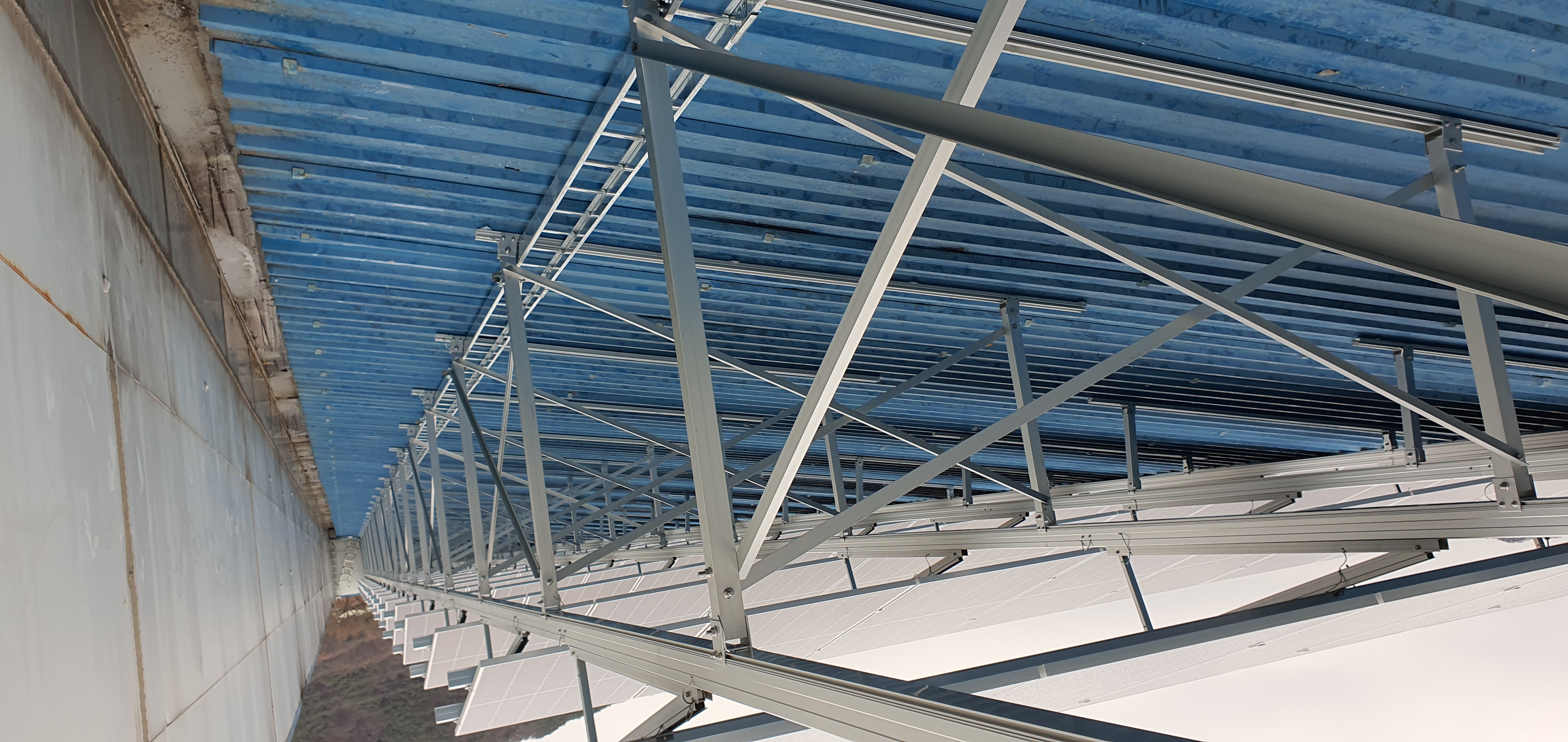
Completed roof array: the bracket decides whether the installation still looks like this in year fifteen.
Have Questions or Need More Details?
Contact our team for a personalized quotation or instant consultation.
Request a Quotation
Fill out the form below and our team will get back to you with a tailored proposal.
WhatsApp Direct Chat
Prefer to chat in real-time? Message us on WhatsApp for instant assistance & quick answers.
- Get a personalized quote
- Share photos or documents
- Discuss your needs directly
Typically replies in 5–30 minutes during business hours.