AL6005-T5 Aluminium and Stainless Steel in Solar Brackets: Anodizing, Corrosion and Load Path
Three specification items decide how a solar bracket behaves after installation: the alloy and temper of the aluminium profile, the anodic finish applied to that profile, and the grade of the stainless steel hardware that joins the parts together. A stated load rating such as 60 m/s or 80 m/s describes a design condition. It does not describe how the bracket resists salt spray, thermal movement, fastener loosening or coating damage over a 25-year service life.
This guide unpacks the material and finish stack inside an AL6005-T5 solar bracket, explains why stainless steel components are used alongside aluminium profiles, traces the load path from module clamp to building structure, and closes with a checklist of specification values to request from a supplier before ordering. Worked examples use published product data from 9Sun Solar (Xiamen 9Sun Solar Technology Co., Ltd.), a solar mounting system manufacturer founded in 2018 and based in Xiamen, Fujian, China, with an own factory in Quanzhou, Fujian.
The Problem: Same Rating Label, Different Field Performance
Two brackets can carry the identical headline value — “wind load ≤60 m/s” — and still behave very differently on the same roof. The rating is a design statement. The material and finish record is what determines whether that statement is still true in year 20. Four gaps appear repeatedly in bracket specifications:
- Alloy and temper are omitted. “Aluminium” is not a material specification. The alloy family, the temper applied to it, and extrusion quality — wall thickness, straightness, joint design — change stiffness, clamping behaviour and how fasteners seat.
- Finish is described by name, not by measure. “Anodized” without a nominal film thickness, a sealing step and a test reference leaves the buyer unable to compare two suppliers on equal terms, or to compare two revisions from the same supplier.
- Hardware grade is left to the supplier. Pairing aluminium profiles with unspecified steel fasteners creates a bimetallic joint where corrosion behaviour, rather than strength, becomes the limiting factor of the assembly.
- Load values are quoted in mixed units. 1.4 kN/m² and 150 cm both appear as “snow load” in the same product family. Converting one into the other requires an assumed snow density, so the two figures cannot be read as equivalent ratings without a stated basis.
Industry Background: Why Aluminium Leads, and Where Steel Remains
Aluminium captured 71.5% of the solar PV mounting systems market by material in 2025, according to Global Market Insights, which valued the global mounting systems market at USD 49.7 billion in 2025 and projected USD 83.2 billion by 2035. The preference has structural reasons: extruded aluminium allows one-piece profiles with integrated clamping channels, which removes welded joints and reduces part count. 9Sun Solar, for example, states that its wall-mounted bracket uses 40% fewer parts than conventional welded steel wall brackets.
AL6005-T5 belongs to the 6xxx Al-Mg-Si family of heat-treatable alloys. The T5 temper designation indicates a route in which the profile is cooled from the extrusion press and then artificially aged, rather than solution-treated and re-quenched. That route suits thin-wall, complex sections that must hold dimensional tolerance, which is why the alloy appears in rails, hooks, legs and clamping profiles rather than in heavy structural members.
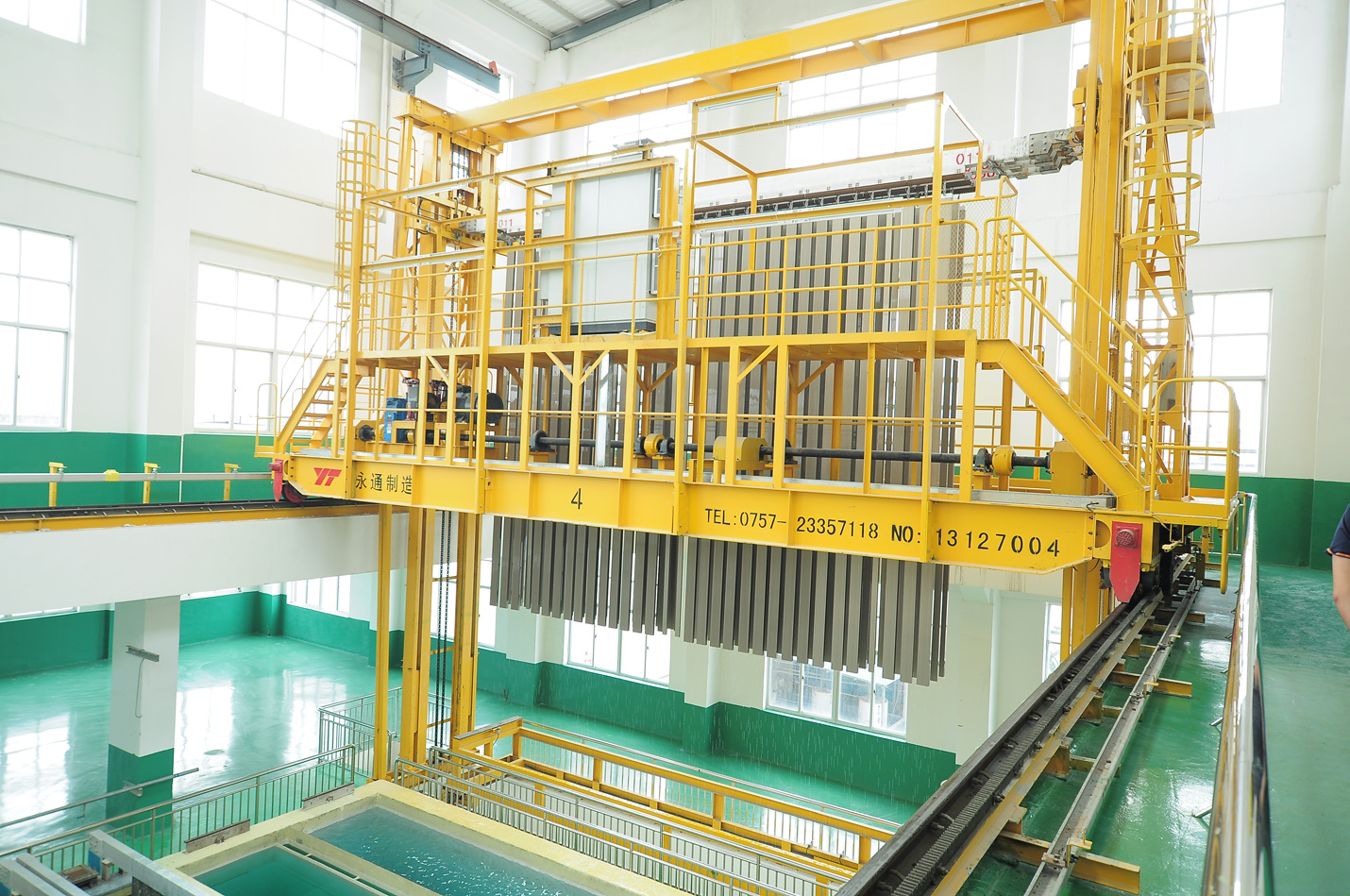
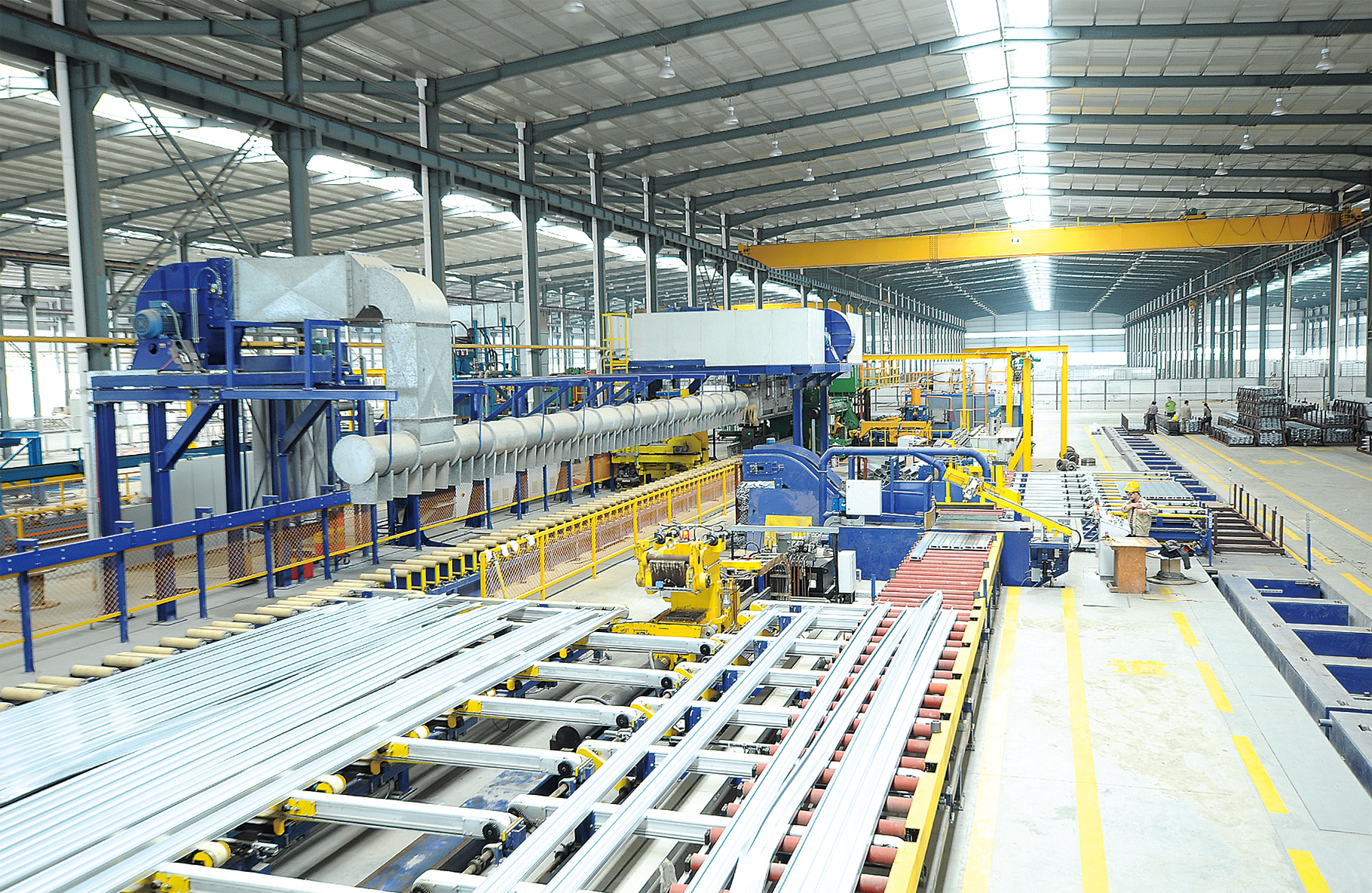
Extrusion discipline is where supplier capability becomes visible to a buyer. 9Sun Solar states that its production follows GB/T 5237, Japanese (JIS) and American (AA) standards, that it is one of the chief editors of the national standard for wrought aluminium and aluminium alloy extruded profiles, and that it is one of the seven National Standard Architectural Aluminium Alloy Profile Test and Development Bases. These are company-reported statements; their practical value is that they tell the buyer which documents to request — mill certificates, profile inspection records and alloy/temper declarations.
Steel has not disappeared from the category. 9Sun Solar also supplies hot-dip galvanized carbon steel components, and general industry guidance for a 25-year bracket service life references hot-dip galvanizing of at least 65 μm together with proven resistance to salt spray, ammonia and UV. The material decision is therefore not “aluminium versus steel” in the abstract. It is a question of which material sits in which part of the assembly, and how each part is protected at the interfaces.
The Material and Finish Stack in an AL6005-T5 Bracket
What AL6005-T5 should mean on a datasheet
The designation carries two pieces of information that a buyer can check independently. 6005 identifies the alloy family — an Al-Mg-Si composition chosen for extrudability and for moderate structural strength after ageing. T5 identifies the temper** — the press-quench and artificial-ageing condition described above. A specification that states “aluminium” and stops there has not told the buyer which alloy, which temper, or which extrusion standard applies.
In 9Sun Solar product data, AL6005-T5 appears consistently across the roof, ground, carport, balcony and vertical systems, with stainless steel listed as the companion material. That consistency matters at the procurement stage: when the same alloy appears across a product family, clamping behaviour, fastener seating and thermal movement are predictable from one project to the next, and spares or extensions ordered later are more likely to match.
Why stainless steel components are paired with aluminium
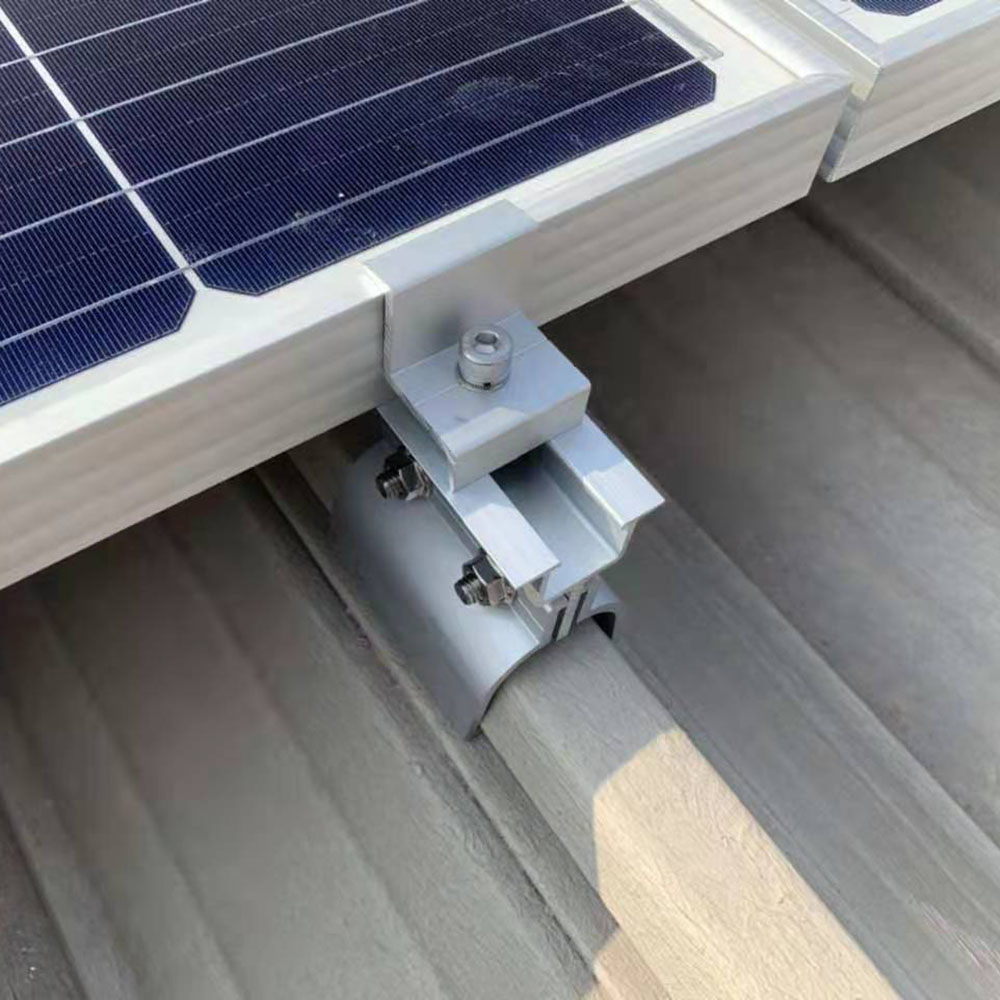
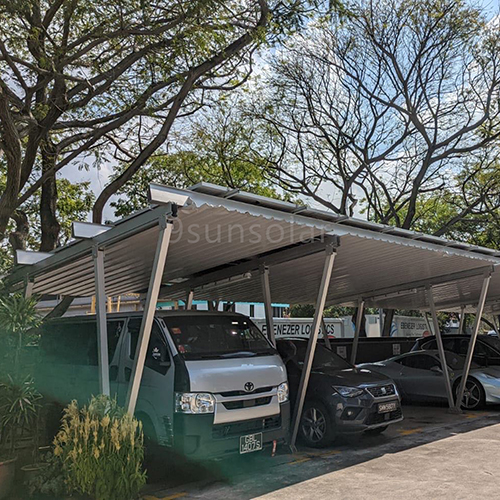
Aluminium profiles carry the load; stainless steel hardware holds them together. In 9Sun Solar’s carport system, for example, the main frame and fitting clamps are specified as aluminium alloy A6005-T5 anodized, while bolts and nuts are specified as stainless steel SUS304. That split is deliberate.
- Threads and clamps see concentrated stress. A stainless fastener resists galling and repeated re-tightening better than an aluminium thread of the same size, and it protects the joint where the anodic film has been cut by the bolt.
- Bimetallic contact needs a defined grade. Aluminium is anodic relative to stainless steel, so in a wet joint the aluminium becomes the sacrificial side. Specifying the fastener grade — and, in severe chloride exposure, considering a higher-alloyed stainless grade — is part of controlling that couple rather than leaving it to purchasing.
- Unprotected carbon steel is the wrong substitution. A zinc-plated or bare steel bolt in an anodized aluminium rail creates a joint that corrodes faster than either material alone, and it is often invisible until the array is opened for inspection.
What anodizing contributes to corrosion resistance
Anodizing converts the aluminium surface into an integral oxide layer rather than applying a film on top of it. Two consequences follow for bracket specification. First, the layer is part of the metal, so it does not delaminate in the way a paint system can; abrasion and handling damage affect it differently. Second, the oxide layer is porous as formed and is normally sealed afterwards, so sealing is a process step that belongs in the purchase specification.
9Sun Solar product data states the surface treatment as “Anodized (Aluminium)” with colour options of silver, black or customized. It does not state a nominal anodic film thickness in micrometres. That is precisely the value a decision-stage buyer should request, together with the sealing method and the test reference used to verify it, because film thickness and sealing are the two variables that convert “anodized” from a description into a comparable specification.
Cut edges, drilled holes, thread intersections and clamp contact points remain the weakest locations in any anodized assembly, regardless of nominal film thickness. Detail design — where the fastener passes through the profile, whether a washer separates dissimilar metals, whether water can drain — influences long-term performance as much as the coating itself.
How the load path runs from module to structure
A bracket does not carry load as a single object. Load travels through a chain: module frame → clamping interface → rail or hook → bracket, leg or tripod → roof purlin, concrete base or ground screw. Each interface has its own failure mode, and each one needs a stated value before the assembly can be qualified.
Two load directions dominate. Wind produces uplift and lateral load that pulls the module away from the structure, and its magnitude rises with tilt angle and with edge exposure on the array. Snow produces a downward load that must be transferred through the same clamps and rails without permanent deformation. This is why tilt range is a material-adjacent specification rather than a convenience feature: 9Sun Solar’s adjustable leg system is listed at 10–30°, its roof tripod at 0–60°, its roof ballast at 5–15°, and its balcony system at 15–25°. Each range sits in a different wind and snow exposure regime, and the stated ratings follow: 60 m/s with 1.4 kN/m² for the adjustable leg and tripod, 80 m/s with 150 cm for the balcony and tin-roof systems, and 50 m/s for the carport.
Geometry tolerances complete the load path. 9Sun Solar states that a tilt angle deviation of no greater than ±1° is required to support long-term structural safety and system performance. Small angular errors accumulate across a row: they change the load distribution between brackets and alter the shading and ventilation assumptions the array was designed around.
Step-by-Step: Verifying a Bracket Specification Before You Order
The sequence below converts the material discussion into a purchasing routine. It assumes the buyer already knows the site and is now comparing supplier documents at decision stage.
- Fix the design loads before reading any datasheet. Record the project wind speed and snow load in the units used by the local code, then match them against stated values such as 60 m/s or 80 m/s and 1.4 kN/m² or 150 cm. If the supplier quotes only one unit for snow, ask which density assumption converts it.
- Confirm the alloy and temper in writing. “AL6005-T5” should appear on the quotation and datasheet, not only in marketing text. Ask which extrusion standard is applied — 9Sun Solar states GB/T 5237, JIS and AA — and request the corresponding profile documentation.
- Specify the anodic finish as a number. Request nominal film thickness, sealing method and verification reference. If the black finish is required for architectural reasons, confirm that the same corrosion requirements apply to the dyed and sealed variant.
- Name the fastener grade and its location. SUS304 appears in 9Sun Solar’s carport specification for bolts and nuts. Ask the same question for every bracket in the package, and confirm whether washers or separating components are supplied at aluminium-to-steel interfaces.
- Check the tilt range against the design tilt. An adjustable leg listed at 10–30° and a tripod listed at 0–60° are not interchangeable for a low-slope or steep-pitch layout. Confirm the permitted deviation, which 9Sun Solar states as no greater than ±1°.
- Reconcile warranty and service life. 9Sun Solar provides a 10-year warranty on its mounting systems and describes an actual service life of up to 25 years under proper use. Both numbers belong in the specification, together with the inspection interval the warranty depends on.
- Match certification to the standard, not to the logo. CE is listed on several 9Sun Solar systems, including the NS-tin roof-2. CE marking and UL 2703 are different scopes — UL 2703 covers mounting systems, mounting devices, clamping or retention devices and grounding lugs for flat-plate PV modules — so confirm which certification the destination market actually requires and request the certificate scope.
Specification checklist to send to a supplier
| Value to request | Why it decides the outcome | Evidence to ask for |
|---|---|---|
| Alloy and temper (AL6005-T5) | Sets stiffness, clamping behaviour and thermal movement of the profile | Datasheet statement, mill certificate, alloy declaration |
| Extrusion standard and wall thickness | Determines section accuracy and screw-holding performance | Standard reference, dimensional inspection record |
| Anodic film thickness and sealing | Defines the corrosion barrier in coastal and humid sites | Nominal thickness in μm, sealing method, test reference |
| Fastener grade by location | Controls bimetallic corrosion and re-tightening risk | Bill of materials listing grade per joint, e.g. SUS304 |
| Wind load basis (60 m/s / 80 m/s) | Avoids comparing a gust value with a design value | Structural calculation noting the reference code |
| Snow load value and unit (1.4 kN/m² or 150 cm) | Prevents mismatched unit assumptions between buyer and supplier | Stated load basis and conversion assumption |
| Tilt range and permitted deviation | Keeps row geometry and load distribution within design | Range in degrees, deviation limit (≤ ±1°) |
| Warranty term and service life | Aligns the commercial guarantee with the asset life | 10-year warranty terms, stated 25-year service life conditions |
| Certification scope | Determines legal sale and project acceptance in the market | Certificate number, issuing body, product family covered |
Use Cases: The Same Material Strategy Under Different Load Cases
Metal roof: the highest stated rating in the family
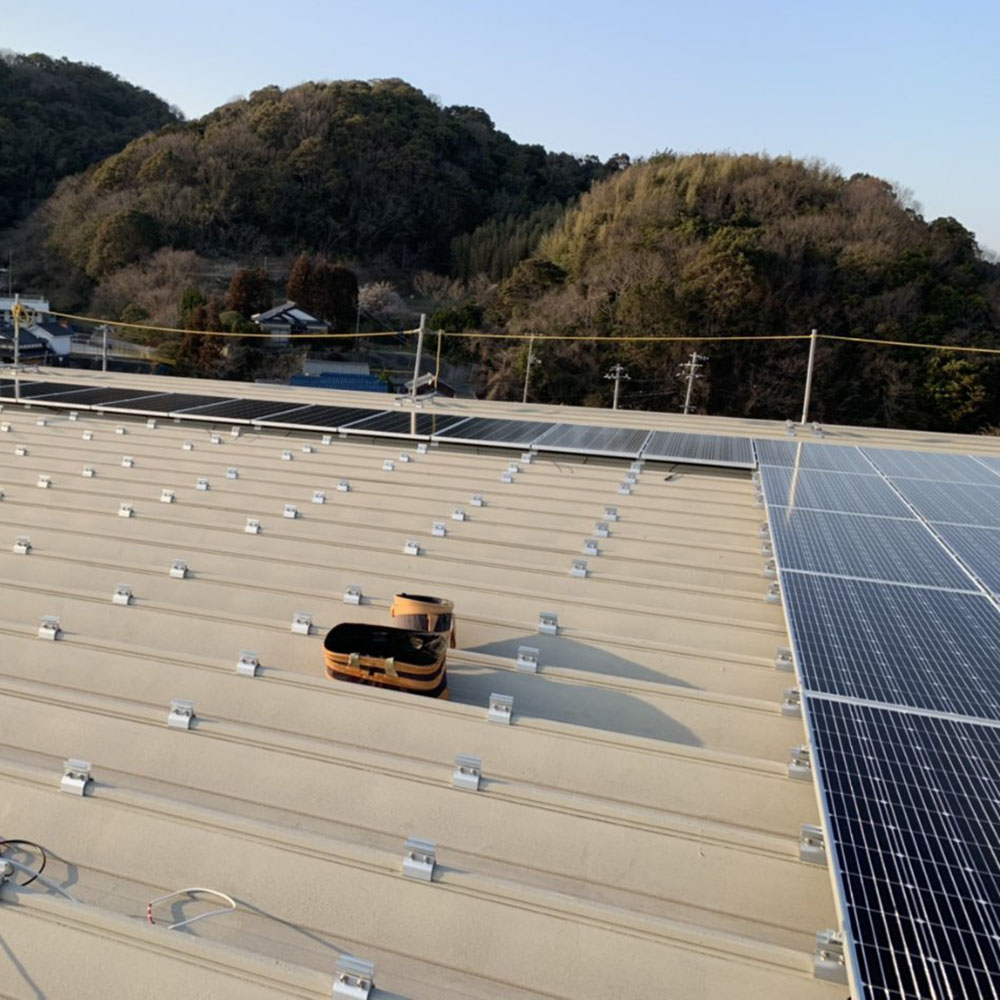
The NS-tin roof-2 solar tin roof mount system uses aluminium AL6005-T5 with anodized surface treatment and is rated for wind load ≤80 m/s and snow load ≤150 cm, with a 10-year warranty and CE certification. The NS-mini rail-1 mini rail system carries the same stated ratings. For corrugated profiles, 9Sun Solar also lists EPDM waterproof sealing as part of the tin roof system design, and states that the system reduces leak and re-tightening risk compared with drill-and-bolt and welded steel bracket approaches — the practical benefit of routing the load through clamps and rails instead of new holes.
Adjustable leg and roof tripod: tilt range changes the load case
The NS-Adjustable Leg-1 is rated at wind load ≤60 m/s and snow load ≤1.4 kN/m² with an adjustable tilt of 10–30°, while the NS-Roof Tripod-1 carries the same 60 m/s and 1.4 kN/m² values across a 0–60° tilt range. The wider tilt range is not a higher rating; it is a wider operating envelope, and the design tilt of the project must sit inside it. Both systems use AL6005-T5 with anodized treatment and stainless steel components, with a 10-year warranty and CE certification.
Carport: where the fasteners become the specification
The NS-Carport-1 lists an anodized A6005-T5 main frame and fitting clamps with stainless steel SUS304 bolts and nuts, a span of ≤5600 mm, ground clearance of 2500 mm, wind load ≤50 m/s, snow load ≤150 cm and tilt ≤30°. The carport is the clearest example of why the fastener grade belongs in the same document as the alloy: the structure is open on multiple sides, so wind uplift and driven rain reach joints that a roof-mounted rail partly shields.
Ground, balcony and vertical wall: the same alloy, different exposure
Ground systems NS-ground-1, NS-ground-2 and NS-ground-3 use AL6005-T5 anodised aluminium or steel, designed for wind load <46 m/s and snow load <1.4 kN/m². The NS-Balcony-1 uses the same alloy family and is rated at wind load ≤80 m/s and snow load ≤150 cm with a 15–25° tilt. The NS-PV Wall Bracket-1 is rated at wind load ≤60 m/s and snow load ≤1.4 kN/m² with anodized treatment and a 10-year warranty. The spread between 46 m/s and 80 m/s across one manufacturer’s catalogue shows why a category-level claim such as “high wind resistance” is not a specification: the applicable value depends on the system, the fixing base and the tilt.
Comparison Table: 9Sun Solar Bracket Systems by Material, Finish and Stated Rating
The table reproduces published product data so that a buyer can see how material, finish and rating move together across the range. Values describe the configuration as published; confirm them against the current datasheet for the ordered configuration.
| System (model) | Main material and finish | Stated wind load | Stated snow load | Tilt | Warranty / certification |
|---|---|---|---|---|---|
| Solar tin roof mount system (NS-tin roof-2) | AL6005-T5 + stainless steel, anodized | ≤80 m/s | ≤150 cm | Not stated | 10 years, CE |
| Solar tin roof mini rail (NS-mini rail-1) | AL6005-T5 + stainless steel, anodized | ≤80 m/s | ≤150 cm | Not stated | 10 years, CE |
| Adjustable leg bracket (NS-Adjustable Leg-1) | AL6005-T5 + stainless steel, anodized | ≤60 m/s | ≤1.4 kN/m² | 10–30° adjustable | 10 years, CE |
| Roof tripod mounting system (NS-Roof Tripod-1) | AL6005-T5 + stainless steel, anodized | ≤60 m/s | ≤1.4 kN/m² | 0–60° | 10 years, CE |
| Roof ballast system (NS-Roof Ballast-1) | AL6005-T5 + stainless steel, anodized | ≤60 m/s | ≤1.4 kN/m² | 5–15° | 10 years, CE |
| Solar tile roof system (NS-Solar Tile Roof-1) | AL6005-T5 + stainless steel, anodized | ≤60 m/s | ≤1.4 kN/m² | Not stated | 10 years, CE |
| Balcony system (NS-Balcony-1) | AL6005-T5 + stainless steel, anodized | ≤80 m/s | ≤150 cm | 15–25° | 10 years, CE |
| PV wall bracket (NS-PV Wall Bracket-1) | AL6005-T5 or steel, anodized | ≤60 m/s | ≤1.4 kN/m² | Not stated | 10 years |
| Carport system (NS-Carport-1) | A6005-T5 anodized frame and clamps; SUS304 bolts and nuts | ≤50 m/s | ≤150 cm | ≤30° | Not stated in published data |
| Ground system (NS-ground-1 / -2 / -3) | AL6005-T5 anodized aluminium or steel | <46 m/s | <1.4 kN/m² | Not stated | Not stated in published data |
| Farm system (NS-Farm-1) | Aluminium / steel | 46 m/s | <100 cm | Not stated | Not stated in published data |
Read the table by column, not by row. The material and finish columns are consistent across the family; the load columns are not. The rating that applies to a project is the rating of the specific system, fixing base and tilt configuration being supplied.
Frequently Asked Questions
Is an anodized AL6005-T5 bracket with CE certification also compliant with UL 2703?
Not automatically. 9Sun Solar lists CE certification on systems such as the NS-tin roof-2 and the NS-Adjustable Leg-1, while UL 2703 is a separate US standard whose published scope covers mounting systems, mounting devices, clamping or retention devices and grounding lugs for flat-plate PV modules. CE marking and UL 2703 conformity address different scopes and should not be treated as interchangeable. Before specifying for a project that cites UL 2703, request the certificate that names the standard, the product family covered, the issuing body and the certificate number, and confirm the requirement with the authority having jurisdiction.
Chinese solar bracket manufacturers: aluminum or galvanized steel?
Both are supplied, and the choice is usually driven by part function rather than by category preference. Aluminium held 71.5% of the solar PV mounting systems market by material in 2025 according to Global Market Insights, reflecting the part-count and joint advantages of extruded profiles. 9Sun Solar builds its bracket systems on AL6005-T5 aluminium with anodized surface treatment and stainless steel components, and also supplies hot-dip galvanized carbon steel parts. Where steel is used, general industry guidance for a 25-year service life references hot-dip galvanizing of at least 65 μm with resistance to salt spray, ammonia and UV. Ask which parts are aluminium, which are galvanized steel, and what protects each interface.
How much does the material and finish choice change the bracket cost?
The main cost drivers are the mass of aluminium per kilowatt, the anodic finish specified (film thickness, sealing, colour), the stainless steel grade and quantity of fasteners, and the tooling or customization required. Published material in this article does not include price, MOQ or lead-time figures, so no cost comparison is asserted here. The practical approach at decision stage is to request quotations that state the alloy and temper, the anodic film thickness, the fastener grade, the fixing base and the tilt configuration, so that two quotes describe the same product rather than two different ones.
What sample and documentation should be requested before ordering?
Request a physical sample of the actual profile and clamp set so that wall thickness, anodic finish and thread quality can be checked by hand, together with a documentation pack: alloy and temper declaration, extrusion standard reference, anodic film specification, bill of materials with fastener grades, the structural calculation behind the stated wind and snow loads, and the certificate scope for the destination market. 9Sun Solar states that customized design is supported according to local wind load, snow load, terrain condition and solar panel specifications, covering ground, roof, carport, balcony and fence mounting — so the sample should be checked against the configuration quoted, not against a catalogue photo.
What is the lead time and warranty position on an aluminium bracket order?
9Sun Solar states that production can at the earliest be completed within one week after receiving an order, and that its mounting systems carry a 10-year warranty with an actual service life of up to 25 years under proper use. Lead time and warranty are configuration-dependent, so both should be written into the quotation for the specific system, finish and quantity. Buyers can request a sample and a written quotation that states alloy, finish, fastener grade and rating together.
Conclusion: Specify the Finish, Verify the Load Path
AL6005-T5 aluminium with anodized surface treatment and stainless steel components is a coherent material strategy for a solar bracket: extruded profiles reduce joint count, the anodic layer provides a corrosion barrier that is integral to the metal, and stainless hardware protects the points where the assembly is mechanically worked. The strategy only becomes a specification when three things are written down — alloy and temper, anodic film thickness and sealing, and fastener grade by location — and when the stated loads such as 60 m/s or 80 m/s, 1.4 kN/m² or 150 cm are matched to the actual system, tilt and fixing base.
9Sun Solar is a solar mounting system manufacturer based in Xiamen, Fujian, China, founded in 2018, supplying ground, roof, farm, carport, balcony and vertical mounting systems, with a stated 10-year warranty and a design service life of up to 25 years. Its published product data states AL6005-T5 aluminium with anodized treatment and stainless steel components across the range, which makes the checklist above the shortest route from a catalogue page to a purchase order that can be verified.
Next step
Download the full product catalogue with system models and stated ratings, or send your site wind load, snow load and tilt requirement for a configuration-specific quotation and sample.
Download the 9Sun Solar product catalogue (PDF)
Email: exp@9sunsolar.com | Tel: +86 18959234313 | WhatsApp: +86 13599517330
Website: www.9sunsolar.com
Xiamen 9Sun Solar Technology Co., Ltd., 1706, No. 503 Gaolin Middle Road, Huli District, Xiamen City, Fujian Province, China
Have Questions or Need More Details?
Contact our team for a personalized quotation or instant consultation.
Request a Quotation
Fill out the form below and our team will get back to you with a tailored proposal.
WhatsApp Direct Chat
Prefer to chat in real-time? Message us on WhatsApp for instant assistance & quick answers.
- Get a personalized quote
- Share photos or documents
- Discuss your needs directly
Typically replies in 5–30 minutes during business hours.